Mass & Weight
Newton's Laws
Gravity
Forces
100
Define mass. Is it a scalar or vector quantity?
A measure of all the matter in an object, scalar
100
What is Newton's 1st Law of Motion?
An object at rest stays at rest, an object in motion stays in motion unless acted on by another force.
100
Define gravity.
The force by which a planet or other body draws objects toward its center.
100
Define force.
A push or pull on an object
200
Define weight. Is it a vector or scalar quantity?
A measure of the gravitational pull on an object, vector
200
Newton's 1st Law of Motion is relates to what property of matter? What scalar quantity directly affects this property?
Inertia, mass
200
What factors affect gravitational force?
mass and distance
200
If an object is accelerating, the forces acting on it are __________.
unbalanced
300
An astronaut weighs 150 lbs on Earth. Will he weigh the most on Earth, Jupiter, the moon, or Mars?
Jupiter
300
Newton's second law of motion describes acceleration as force divided by __________.
mass
300
If the mass of an object doubles, what happens to gravitational force?
Gravitational force will double.
300
The box on the ramp is not moving. What force prevents it from sliding down?

friction force
400
Draw a graph of mass (mass vs. gravitational force) that shows the effect of increasing mass on gravitational force.
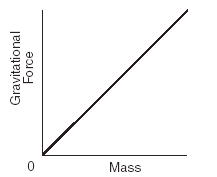
400
Newton’s law states that for every action, there is an ________ reaction.
equal and opposite
400
If the distance between two objects doubles, what happens to the gravitational force?
It gets 4 times weaker.
400
What force prevents the box from falling through the ramp? What is the source of this force?
normal force from the ramp
500
Draw a graph of distance (distance v time) that shows what happens to the distance traveled by a falling object when gravity is the only force acting on it.

500
Explain an action-reaction pair that occurs when someone is swimming.
Some sample answers:
The person pushes on the water and the water pushes back.
The person experiences gravity from the Earth and the Earth experiences gravity from the person.
The water applies a drag force on the person and the person applies a drag force back.
500
What is the force of gravity between object 1 (m1 = 5 kg) and object 2 (m2 = 10 kg) that are 20 m apart?
8.3 x 10⁻¹² N
500
An 8 kg ball is rolling with an initial constant speed of 15 m/s then experiences a friction force of 5 N. How long does it take the ball to stop rolling?
F = ma
a = (vf - vi )/ t
a = F/m = -5/8 m/s2
a = (vf - vi )/ t
-5/8 = (0 - 15) / t
t = 24 s