Natural Selection
Adaptations
Speciation
Cladograms
Evidence of Evolution
100
This type of natural selection chooses for one "extreme"
variation
Directional Selection
100
The three types of adaptation are
Behavioral, Physiological, and Anatomical
100
When populations cannot successfully reproduce together, leading to speciation and diversity of life, it is known as
Reproductive isolation
100
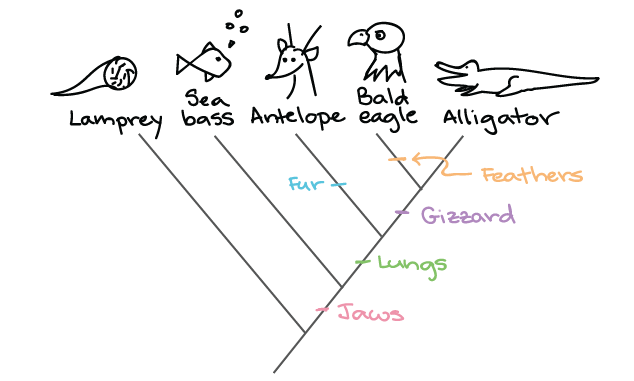 According to this cladogram, antelopes, bald eagles, and alligators all share these two traits.
Jaws and Lungs
100
Relative dating of fossils can be used to determine how old they are compared to one another. Older fossils will tend to be in these layers of rock.
Lower/bottom/deeper
200
This type of natural selection chooses for the average variation of a trait.
Stabilizing selection
200
Mutated hemoglobin protein in Sickle Cell Disease is an example of this type of adaptation
Physiological
200
These are the two types of reproductive isolation
Geographical and Behavioral
200
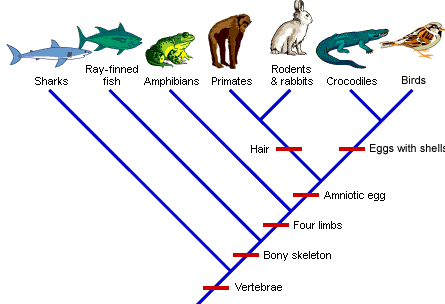
Primates and Rodents/Rabbits
200
Similar traits in different species that share a common ancestor are known as this
Homologous structures
300
A population of finches evolving to have both birds with large beaks for cracking open nuts as well as small beaks for picking bugs out of trees is an example of this type of selection.
Diversifying / Disruptive
300
Stick bugs looking identical to twigs on a tree branch is an example of this type of adaptation.
Anatomical
300
A river forming near a coastline and gradually cutting off a piece of land from the rest of the region is an example of this type of isolation
Geographic
300
 These four species form a clade on this cladogram.
Primates, rabbits/rodents, crocodiles, and birds
300
Remnants of a structure that were functional in an ancestor but no longer have a use are known as
Vestigial structures
400
Peacocks with smaller tails have trouble finding a mate, while those with larger tails cannot escape from predators easily. Thus, the population of peacocks evolved to have mostly medium-sized tails. This is an example of...
Stabilizing Selection
400
Snow geese migrating south for the winter to find food is an example of this type of adaptation.
Behavioral
400
The rapid diversification of a species after an extinction or colonization event is known as
Adaptive radiation
400
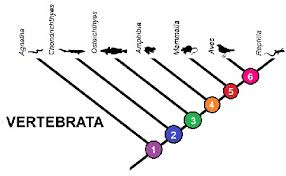 On this cladogram, this node (number) represents the common ancestor of Aves and Amphibia.
4
400
When a similar trait evolves separately in species with no common ancestor, it is known as
Convergent evolution
500
This type of selection leads to an increase in traits that improve an individual's chance of reproducing, but not necessarily surviving.
Sexual selection
500
During the colder season, some species of reptile will brumate. Their metabolism, heart rate, and breathing slow, and they tend to burrow and sleep more. This is an example of these TWO types of adaptation.
Physiological and behavioral
500
A population of clover blooms a few weeks earlier than normal, resulting in them not being able to reproduce with the rest of the population, which blooms on schedule. This is an example of this type of isolation
Behavioral
500
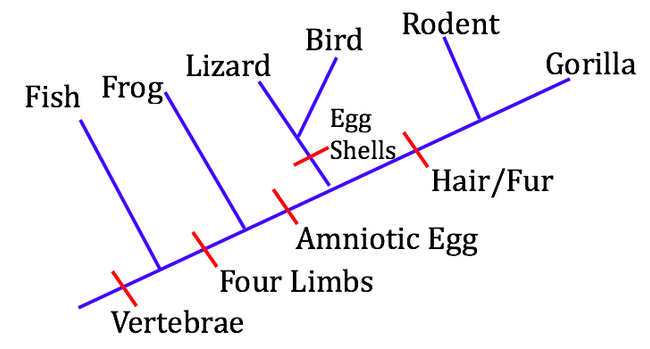 According to this cladogram, this species has four limbs and does not lay amniotic eggs.
Frog
500
Closely-related marsupials existing in both Australia and in the Americas is an example of this type of evidence for evolution.
Biogeography / Biogeographical