Definitely Defining
Creative Concentration
Thirst Quencher
Colligative Conundrum
Steeps and Slopes
100
What are the two parts of a solution? What is the definition for each one?
Solute is the thing being dissolved
Solvent is the thing that does the dissolving
100
What two equations do we use to calculate concentration?
% concentration = mass solute/mass solution x 100%
Molarity = moles of solute/liters of solution
100
Which of the following with NOT dissociate when dissolved in what?
CO2
KNO3
Cl2
NH3
CO2
NH3
Cl2
100
What is a colligative property? What were the colligative properties we discussed in class?
Colligative property - A property that depends on the number of particles dissolved in solution, not the identity of the particles.
The colligative properties we discussed were:
Vapor pressure lowering
Boiling point elevation
Freezing point depression
100
How many grams of KNO3 are dissolved in 100 g of water at 70oC to make a saturated solution?
130 g KNO3
200
What factors influence a solid solute's ability to dissolve?
Temperature
Pressure
Particle size
Stirring
Polarity
200
If more sodium chloride is added to the same amount of water, what happens to the solution?
The molarity of the solution increases because there are more particles in the solution.
200
A solution of potassium chloride conducts electricity well, whereas a sugar solution does not conduct electricity. What terms can we use to describe the properties of both potassium chloride and sugar respectively?
Potassium chloride is an electrolyte (it conducts electricity)
Sugar is a nonelectrolyte (it does NOT conduct electricity)
200
According to colligative properties, how does adding a solute affect the vapor pressure and boiling point of the solution?
Adding solute decreases vapor pressure and increases boiling point.
200
A solution of NaNO3 at 40oC would be supersaturated when there are how many grams of NaNO3 dissolved in 100 g of water?
Any number below 105 g NaNO3
300
The kinetic energy of gas particles allows them to escape from a solution more easily at higher temperatures. Therefore, as a solution’s temperature decreases, what happens to the solubility of a gaseous solute? What effect does temperature have on the solubility of a gas?
The solubility of a gas decreases with increasing temperature
Or
The solubility of a gas increases with decreasing temperature
300
What is the molarity of 2.3 moles of HCl dissolved in 1.2 L of water?
1.92 M HCl
300
Which of these compounds can be classified as electrolytes?
I. Ca(OH)2
II. KCl
III. CCl4
IV. H2O
I. Ca(OH)2
II. KCl
300
Why the Arctic Ocean never completely freezes?
The salt in ocean water lowers the freezing point so that it is harder to freeze
300
Which solutes in the graph displays gas-like behavior? Justify your answer.
Anything that has a negative slope (to show that as temperature increases, solubility decreases). This includes:
HCl
NH3
SO2
400
The solubility of a substance at several different temperatures is listed below:
1.1 g solute per 100. g of solution at 20°C
2.8 g solute per 100.g of solution at 30°C
4.4 g solute per 100.g of solution at 40°C
Based on this data, what type of solute is this: a solid or a gas?
A solid solute
400
If 16.5 grams of Kool-Aid are dissolved in 150.0 grams of water, what is the percent by mass for the solution?
9.91% Kool-Aid
400
Describe the difference in behavior between a salt water solution and a sugar water solution.
Salt is an ionic compound and undergoes dissociation when it dissolves in solution. It can also conduct electricity, making it an electrolyte.
Sugar is a covalent compound and does not undergo dissociation, it only undergoes solvation. Thus, it cannot conduct electricity, making it a nonelectrolyte.
400
Why we salt the road before it snows?
The salt on the road lowers the freezing point of water so that it is harder to freeze
400
If you prepared a saturated aqueous solution of NH4Cl at 37°C and then heated the solution to 69°C, would the new solution be saturated, unsaturated, or supersaturated? Justify your answer.

It would be unsaturated because as you heated the solution, the solubility of the solution increased.
500
Major Concept 1: Polar molecules contain elements with different electronegativities, resulting in partial charges that allow them to interact with other polar molecules.
Major Concept 2: Water is a polar covalent solvent that dissolves polar covalent and ionic compounds because of charged particle attractions.
Major Concept 3: Nonpolar molecules contain elements with different electronegativities, resulting in partial charges that allow them to interact with other polar molecules.
Major Concept 4: Like dissolves like.
What major concepts do all four models illustrate?

Major Concepts 1, 2, 4
500
What is the molarity of a CaCl2 solution that has 247.5 g of solute and a volume of 8.55 L?
0.26 M CaCl2
500
Major Concept 1: Covalent compounds dissociate and ionic compounds do not.
Major Concept 2: Water is a polar covalent solvent that dissolves polar covalent and ionic compounds because of charged particle attractions.
Major Concept 3: Each covalent compound forms 1 particle when dissolved and each ionic compound forms 2 or more particles when dissolved.
Major Concept 4: Positive and negative ions are separated when ionic compounds dissolve but not when covalent compounds dissolve.
What major concepts do all four models illustrate?
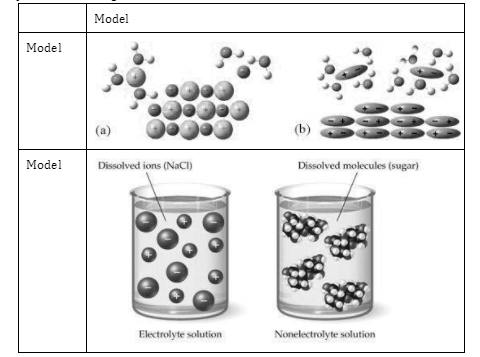
Major Concepts 2, 3, 4
500
Why do we add antifreeze to a car radiator?
To lower the freezing point of the water in the radiator and raise the boiling point of the water in the radiator. This protects the radiator throughout the year.
500
How many grams of sodium nitrate can dissolve in 450 g of water at 10° C?
360 g NaNO3