Lewis Structures
Molecular Geometry
IMFs
More IMFs!
100
This is the lewis structure of CO2
What is a diagram with carbon in the middle, a double bond to each oxygen, and 2 lone pairs on each oxygen?
100
This is the geometry of CH4
What is tetrahedral?
100
These IMFs are present in polar molecules.
What are dipole forces?
(H-bonding acceptable in H being bonded to N,O,F, or Cl)
100
This is a property of a substance with weaker IMFs
What is a fast evaporation rate OR low boiling point OR low melting point OR low cohesion?
200
This is the lewis structure for CCl4
What is a diagram with C in the middle, a single bond to each Cl, and 3 nonbonding pairs on each Cl?
200
This is the geometry of CS2
What is linear?
200
This is a particle diagram that correctly points at hydrogen bonding forces in water.
What is a diagram that shows at least 2 water molecules with a dotted line going between a hydrogen of one molecule and the oxygen of the other.
200
This is the molecule from the pair that has a higher boiling point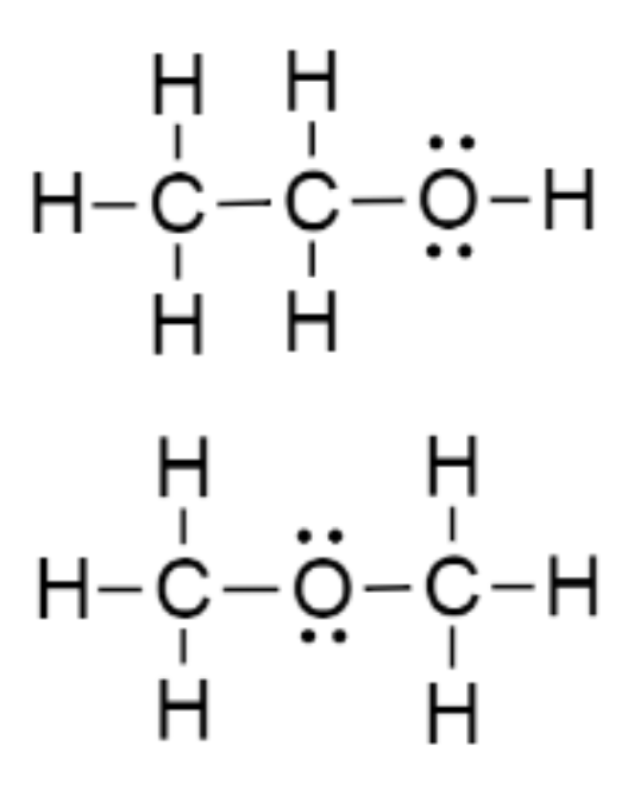
What is the first one?
300
This is the only molecule out of the 3 that has nonbonding pairs on the central atom.
CO2, SF2, CH4
What is SF2?
300
This is a description of how electron domains interact to determine the geometry around an atom.
What is the electron domains repel each other and put the largest angle possible between each domain.
300
Out of C2H6 and C4H10, this compound will have a higher boiling point.
What is C4H10?
300
This type of IMF will be present in a molecule that is only made of carbon and hydrogen.
What are dispersion forces?
400
This is a lewis structure of OBr2 that shows the partial charges on each atom
What is a diagram with:
O in the middle with one bond going to each Br and 2 nonbonding pairs
Each Br has 3 nonbonding pairs
Br is partially positive, O is partially negative
400
Out of CO2 and CH4, this molecule has the smaller angles between each bond.
What is CH4?
400
Out of CO2 and NH3, this compound will dissolve in water better.
What is NH3?
400
This explains why CO2 is nonpolar.
What is the polar bonds have symmetry and cancel each other out?