Colonial America
The Enlightenment
American Independence
Westward Expansion
Civil War & Reconstruction
100
What three groups were involved in the French and Indian War?
1. France
2. Great Britain
3. Native Americans
100
What was the Enlightenment?
A movement when reason and knowledge were thought to lead to progress and advancements
100
What's the difference between a Patriot and a Loyalist?
Patriot: wanted American independence from Great Britain
Loyalist: wanted to stay under the control of Great Britain
100
What mode of transportation did Americans use the most to travel West?
Wagons
100
What were the two sides of the Civil War?
1. Union
2. Confederacy
200
What was the main cause of the French and Indian War?
France and the British-controlled American colonies wanted control over the Ohio River Valley for trade and agriculture.
200
Which Enlightenment thinker argued that humans are naturally competitive and can't be trusted to rule themselves?
Thomas Hobbes
200
What are two reasons why the colonies would have wanted independence from Great Britain?
1. trade with other countries besides Great Britain
2. voting rights
200
Why was the Missouri Compromise necessary?
To keep the balance between slave and free states (11 each)
200
What is a literacy test and why were they used?
Test that measures a person's ability to read and write. Acted as barriers to voting for African Americans, specifically in Southern states.
300
What is salutary neglect?
The practice of avoiding strict enforcement of parliamentary laws meant to keep British colonies obedient to England
300
Which Enlightenment thinker most likely wrote the following quote?
"All mankind... being all equal and independent, no one ought to harm another in his life, health, liberty or possessions."
John Locke
300
Who was the first president of the United States?
George Washington
300
What vocabulary term is best demonstrated by the painting American Progress by John Gast? (Pictured below)
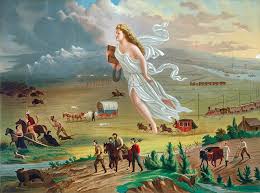
Manifest destiny
300
What were Black Codes? How did Black Codes impact the lives of African Americans?
Black codes: laws that interfered with African Americans' ability to have access to their rights
400
What are three ways that the British ended salutary neglect?
1. Sugar Act
2. Stamp Act
3. Tea Act
400
In his pamphlet titled Common Sense, Thomas Paine wrote the following:
"America would have flourished as much and probably much more had no European power had anything to do with her."
Summarize this quote in your own words!
America would have been better off if Great Britain didn't get involved in their business.
400
What were two weaknesses of the Articles of Confederation?
1. They only met once a year
2. They couldn't collect taxes
3. States couldn't form militaries
400
What is Manifest Destiny?
Belief that the expansion of the US throughout the American continents was both justified and inevitable.
400
How did the Emancipation Proclamation impact slavery?
1. Freed slaves in Confederate states
2. Slaves in Union states remained in slavery
500
Put the following events in order from earliest to latest:
Proclamation of 1763
Boston Massacre
Stamp Act
Tea Act
Sugar Act
1. Proclamation of 1763
2. Sugar Act
3. Stamp Act
4. Boston Massacre
5. Tea Act
500
Which Enlightenment thinker was the opposite in many ways as John Locke? Explain!
Thomas Hobbes - wanted an absolute monarchy, while Locke wanted democracy
500
What was the name of the group that founded the United States' Constitution?
Constitutional Convention
500
What were the three outcomes of the Missouri Compromise?
1. Missouri became a slave state
2. Maine became a free state
3. All territory that the United States gained west of Missouri would be slave territory below the 36'30" line and free above it.
500
Identify and describe all 3 of the Reconstruction Amendments of the Constitution.
13th Amendment: Abolished slavery
14th Amendment: All people born in or naturalized by United States = citizens
15th Amendment: All citizens can vote no matter race or history of enslavement