Ch.6
Ch.17
Ch.17 (2)
Ch.17 (3)
Ch. 18
Ch.18 (2)
Ch.18 (3)
100
Pressure within the vascular system due to the weight of a column of blood
Hydrostatic pressure
100
Synovial fluid from the knee joint
Baker's Cyst
100
How do normal competent perforating veins flow?
Superficial to deep
100
Which vein does not have valves (in most people)
IVC (Inferior Vena Cava)
100
Name the 2 veins of the upper extremity that are NOT considered deep veins
Basilic and Cephalic veins
100
True or False:
The subclavian veins are not normally pulsatile with respiratory phasicity
False; the subclavian veins have both respiratory phasicity AND are pulsatile because of their closeness to the heart
100
True or False:
The subclavian veins may be non-compressible in their normal state due to its position
TRUE!
The clavicle sometimes inhibits us from compressing the subclavian vein
200
What portion of the venous wall do the valves come out of?
Intima
200
How do we assess for vein wall compressibility?
Gentle but firm probe pressure in transverse
200
Does the flow in the lower extremity veins increase or decrease with expiration?
Increases
200
Which of the following does NOT aid lower extremity venous flow in its return to the heart? (Inspiration or Expiration)
Inspiration
200
Normal or abnormal waveform for:
1. IJV
2. Subclavian Vein
3. Brachial Vein
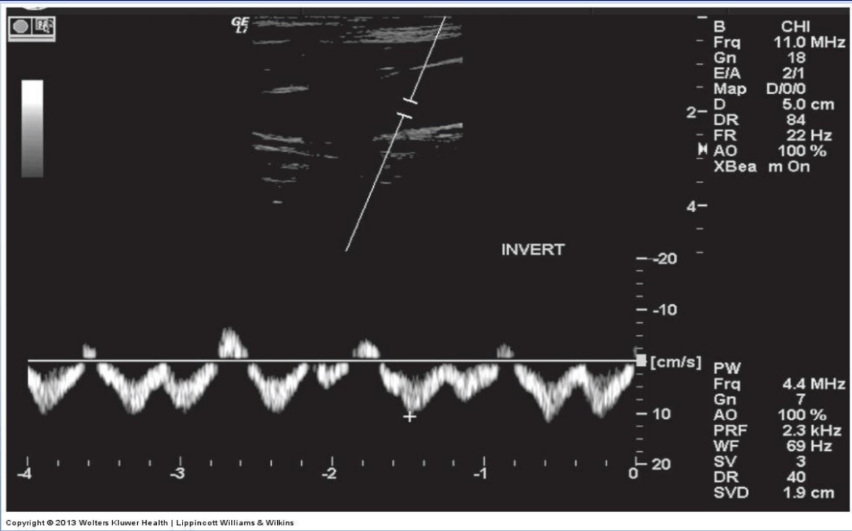
Normal
Normal
Abnormal
200
Does the flow in the veins of the upper extremity increase or decrease with inspiration?
Increase
200
True or False:
The arm has increased flow return to the heart during inspiration, while venous flow return from the legs decreases with inspiration
TRUE!
300
Flow that lacks respiratory phasicity and does not cease with proximal compression or the Valsalva maneuver
Continuous
300
Name A and D
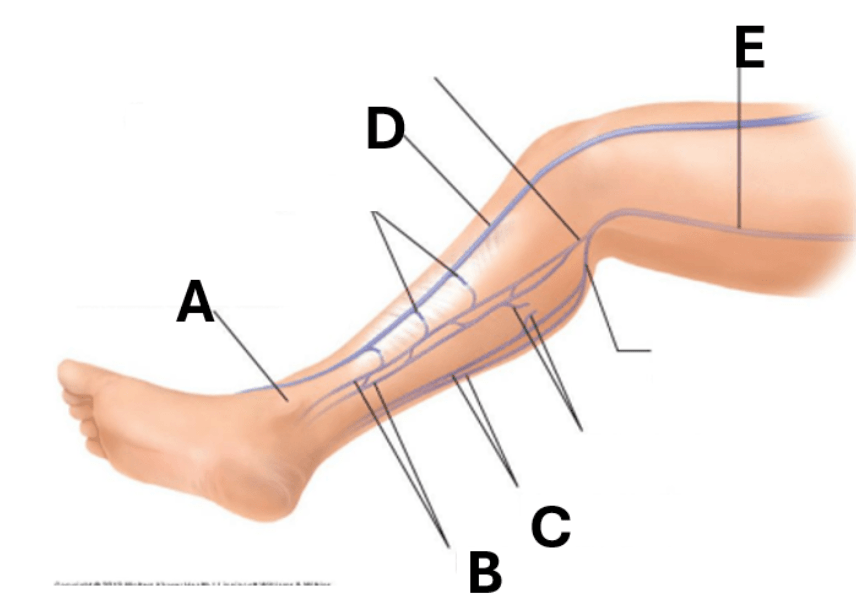
A - Right medial malleolus
D - Right Great Saphenous Vein (GSV)
300
Name B, C, and E
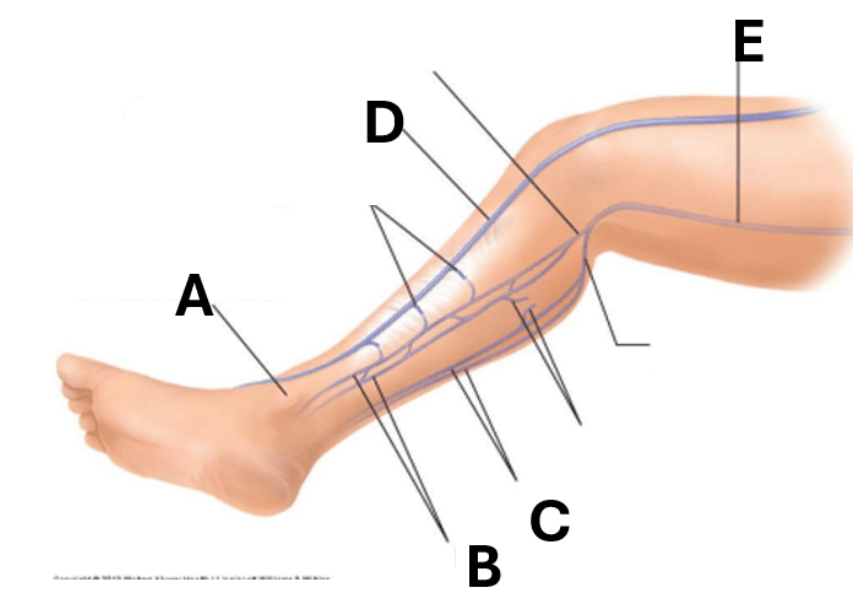
B - Right PTVs (Posterior Tibial Veins)
C - Right Peroneal Veins (Peron V)
E - Right Femoral Vein
300
What kind of thrombus/DVT is the "tail of the dog" related to?
Acute DVT/thrombus
300
Name G, H, and I
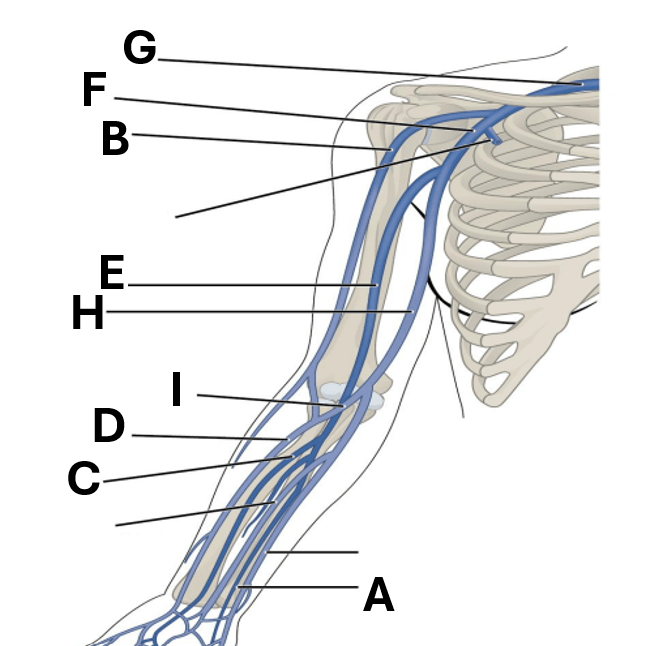
G - Right Subclavian Vein
H - Right Basilic Vein
I - Right Median Cubital Vein
300
What veins come together to create the brachial veins?
Radial and Ulnar Veins
300
Where does the cephalic vein travel?
Anterolateral side of the arm
400
Vein with the greatest number of valves
Great Saphenous Vein (GSV)
400
What does the gastrocnemius vein drain into?
Follow up question:
What are the 2 major muscle veins in the lower legs?
Popliteal vein
Gastrocnemius and soleus veins
400
You are doing a bilateral lower extremity venous ultrasound and find continuous flow in BOTH common femoral veins. What is this finding showing us?
Obstruction in the IVC (Inferior Vena Cava)
400
The small saphenous vein usually drains into what?
Popliteal vein
400
Name the 8 veins we look at during an UEV ultrasound
1. IJV
2. Subclavian Vein
3. Cephalic Vein
4. Axillary Vein
5. Basilic Vein
6. Brachial veins
7. Radial Veins
8. Ulnar Veins
400
What vein connects the cephalic and basilic veins?
Medial Cubital Vein
400
How can you get the subclavian vein to compress if it is behind the clavicle?
Deep and hard sniff from PT
500
Do lower extremity veins exhibit pulsatility with the cardiac cycle?
NO! Only veins closer to the heart will exhibit pulsatility with the cardiac cycle
500
Name the 3 factors in Virchow's Triad
1. Venous stasis
2. Hypercoaguability of blood
3. Injury to vein walls
500
What are the 4 symptoms related to pulmonary embolism that we learned?
1. Tachypnea
2. Chest pain
3. Tachycardia
4. SOB (shortness of breath)
500
What do the soleal sinuses drain into?
Posterior Tibial and Peroneal Veins (PTVs and Peron Vs)
500
What one of the 3 factors in Virchow's Triad is most responsible for DVTs in the upper extremities?
Vein wall damage
500
Name A, B, and C
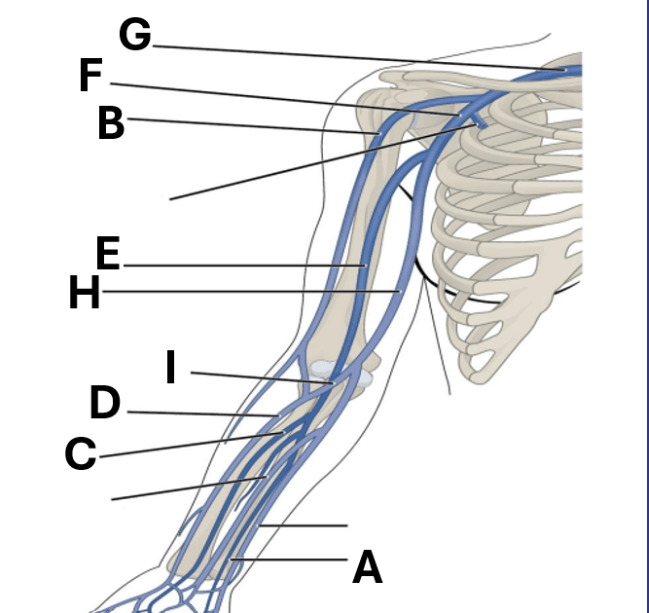
A - Right Ulnar Vein
B - Right Cephalic Vein
C - Right Radial Vein
500
Name D, E, and F
D - Right Cephalic Vein
E - Right Brachial Vein
F - Right Axillary Vein