Learning
Brain Structures in Memory
Memory and Mnenomics
Research Methods
ATSI Approaches
100
Lucy decided to start teaching her daughter, Susie, to tie her shoelaces. Explain how vicarious reinforcement could have been applied to encourage this behaviour
1m: If Susie saw her sister get praised for tying her shoelaces, then she would be more likely to tie her own shoelaces in the future (or any appropriate example of vicarious reinforcement).
100
Mark’s grandfather has recently been diagnosed with Alzheimer’s disease.
A. Describe one effect that Alzheimer’s disease has on the physiology of the brain
1m: Any one of the following: Atrophy of brain tissue (particularly hippocampus), destruction of acetylcholine-producing neurons, amyloid plaques develop, neurofibrillary tangles develop.
100
Nicole was walking down the street when she heard someone call out her name. She turned to see who it was, and after a moment recognised her friend Ebony.
The sound of her name was initially registered in Nicole’s
hippocampus.
iconic memory.
sensory memory.
short-term memory.
sensory memory.
100
Which of the following statements regarding external validity is the most accurate?
- A
External validity is only considered when internal validity is achieved.
- B
External validity is the extent to which an investigation truly measures what it claims to.
- C
External validity is the extent to which the results of an investigation can be applied to different individuals in similar settings.
- D
External validity can be improved by using a stricter inclusion criteria.
A
100
The 8 ways of Aboriginal learning framework is an example of an Aboriginal and Torres Strait Islander approach to learning.
With reference to the 8 ways of Aboriginal learning framework, explain what is meant by the multimodal nature of Aboriginal and Torres Strait Islander ways of knowing and learning.
Aboriginal and Torres Strait Islander approaches to learning are multimodal by nature, meaning that they use a variety of methods.1This is reflected by the 8 ways of Aboriginal learning framework, which demonstrates that Aboriginal and Torres Strait Islander approaches to learning use several different methods, such as story-sharing, learning maps, non-verbal methods, symbols and images, land links, non-linear methods that do not separate pieces of knowledge into distinct points, breaking down a concept into different components through the strategy of deconstruct/reconstruct, and community links.2
200
- Identify two key features of classical conditioning. (2 marks)
- 1m: Repeated associations of presenting a NS immediately before a UCS.
1m: Involves an involuntary (reflexive) response being made to a previously neutral stimulus.
200
The cerebellum plays a key role in the processing and encoding of
implicit, motor memories.
200
Nadeem was asked to purchase 12 items from the bakery. On his way to the bakery, he tried to repeat the items over and over again in his head. When Nadeem arrived at the bakery, he could not remember all of the items. According to the Atkinson-Shiffrin multi-store model of memory, the most likely reason Nadeem was unable to recall all of the items was due to limited
capacity of his short-term memory. 7+-2, not enough time for rehearsal/encoding
200
- Explain two differences between informed consent and debriefing. (2 marks)
- Informed consent occurs before the study whereas debriefing occurs after the study.
- Informed consent informs participants of the true nature of the study, possible risks and participants’ rights whereas debriefing informs participants about the results, conclusions and if there was any deception involved in the experiment.
200
Compare observational learning and ATSI approach to learning by providing a difference and a similarity.
pay attention to model, active learning
relationships, more holistic
300
Compare and contrast operant conditioning and observational learning. (2 marks)
1m: Similarity:
- Both rely on consequences (reinforcement and/or punishment) of voluntary behaviour
- The learner is active in both forms of learning
- The learner must be motivated in both forms of learning
- Both forms of learning rely on voluntary motor responses
1m: Difference:
Observational learning occurs indirectly/via observation (or vicariously), whereas the consequences of behaviour are experienced directly in operant conditioning.
In operant conditioning, there is observable evidence of learning, whereas in observational learning there is a distinction made between acquisition and performance.
300
State a function of the following brain structures in relation to memory
1m: Amygdala –Encodes/forms implicit, emotional memories.
1m: Hippocampus –Encondes/forms explicit memories.
300
Identify three types of mnemonics in written cultures and two types of mnemonics in oral cultures.
acronym, acrostic, methods of loci
sung narrative songlines
300
In a replication of Ivan Pavlov’s classical conditioning experiment, researchers measured the salivation response of 10 dogs over multiple trials.
In Stage A, the researchers presented the dogs with the sound of a buzzer, followed by food. In stages B, C and D, the researchers presented the sound of the buzzer alone. They measured how much the dogs salivated.
Identify the IV, DV and type of experimental design
IV Stimulus (food, buzzer, both)
DV volume of saliva
between subjects
300
Identify the 4 out of the 8 ways of learning according to ATSI approach to learning.
Stories, learning maps, non verbal, symbols/images, community links, deconstruct/reconstruct, non-linear, land links
400
- One of your classmates failed to submit their homework on time.
- With reference to the 3-phase model of operant conditioning, explain how your teacher could ensure that they completed their work on time in the future. (4 marks)
1m: Antecedent: Teacher sets homework for a certain date.
1m: Behaviour: Student does not complete their work by the due date OR completes work on time.
1m: Consequence: Teacher removes a star from the chart which would decrease the likelihood of the student not completing their homework again
1m: This would act as negative punishment
OR teacher puts a star on the chart to increase the likelihood of the student completing work on time in the future.
1m: This would act as positive reinforcement
400
Henry was 27 years old when he underwent surgery for frequent and sever epileptic seizures. The surgery involved removing both of the medial temporal lobes of the brain. Although he was cured of epilepsy, Henry was left with an inability to recall any events that had occurred in the two years prior to his surgery and he was unable to retain any new facts or episodes from the time of his surgery until he died at the age of 82. However, researchers working with Henry in the years following his surgery found that Henry could learn new skills.
The removal of which brain structure lead to Henry’s memory problems? (1 mark)
Name the type of long-term memory that was preserved in Henry. (1 mark)
The removal of which brain structure lead to Henry’s memory problems? (1 mark)
1m: Hippocampus (in the medial temporal lobe).
Name the type of long-term memory that was preserved in Henry. (1 mark)
1m: Implicit (procedural) memory.
400
- Which of the following identifies the sub-stores of the multi-store model in the correct order?
A Sensory memory, short-term memory, working memory.
B Episodic memory, semantic memory, procedural memory.
C Short-term memory, declarative memory, procedural memory.
D Sensory memory, short-term memory, long-term memory.
D
400
Pearl is interested in investigating the effectiveness of using approach strategies (strategies that directly confront the source of stress) to cope with stress for high school students. She selects a sample of 20 high-school students and assigns half of the sample to the control and half of the sample to the experimental group.
Pearl’s study provided promising results about the effectiveness of this strategy. However, she is worried that her findings were just a fluke. Describe two measures that Pearl could use in order to ensure her findings are not a ‘one-off’.
Pearl could use the measure of repeatability to analyse the extent to which successive measurements or studies produce the same results when carried out under identical conditions within a short period of time.1She could also use the measure of reproducibility to analyse the extent to which successive measurements or studies produce the same results when repeated under different conditions.2
400
Describe what is meant by the term songline as it applies to Aboriginal ways of learning. (3 marks)
1m. A songline is a sequence of short sung narratives associated with specific locations in the landscape.
1m. These locations are linked by a walked (physically or imagined) path through Country.
1m. They contain cultural knowledge associated with the landscape, map the journey of Ancestral Beings and the living system of all entities that exits within the universe.
500
- Mr Evans, the first aid officer, delivers a presentation at a school assembly on how to use an EpiPen so that staff and students can use one in the case of an emergency. There are 10 students in the school who suffer from anaphylaxis (an allergic reaction, which can be remedied by an EpiPen injection).
- After the talk, most students said that they didn’t remember anything from Mr Evan’s presentation, however, a few weeks later, a classmate had an anaphylactic reaction and his friend successfully delivered an EpiPen shot.
- With reference to the stages of observational learning, explain why the student was able to give the EpiPen shot?. (7 marks)
1m: Attention: Students actively watched the steps involved when giving an EpiPen shot.
1m: Retention: Students formed a mental representation of the steps involved in giving an EpiPen.
1m: Reproduction: Students had the mental and physical capabilities to give an EpiPen. E.g. they had the motor coordination to inject the EpiPen.
1m: Motivation: Students wanted to administer the EpiPen so that their classmate didn’t die.
1m: Reinforcement: Students gave the EpiPen shot and their classmate survived. This makes the student more likely to give an EpiPen (in similar situations) in the future.
500
Liam was in a serious car accident, although he was not injured. In following days, he can’t help thinking about it over and over again. Six weeks later, he drives through the intersection where the accident occurred and he feels anxious. Liam also experiences vivid flashbacks of the accident.
Explain two roles of the amygdala in relation to the scenario above. (2 marks)
1m: It is involved in the consolidation of Liam’s implicit, emotional memory of the car accident.
1m: It is involved in the formation of (classically conditioned) fear responses.
500
Danny has to work in a group with Amelia, Rafa, Toby, Sheron, and Yaakov for an art project. Propose how Danny could use acronyms and acrostics to remember the names of students in his art group.
Danny could use an acronym, which is a mnemonic device in which the first letters of items form a pronounceable word to aid memory1For example, he could use the acronym ARTSY to remember that Amelia, Rafa, Toby, Sheron, and Yaakov are in his art project group.2Alternatively, Danny could use an acrostic, by creating a phrase, rhyme, or poem using the first letters of his peers’ names to aid his memory.3For example, he could use the acrostic ‘Always Remember To Share Yoghurt’ to remember the people in his art project group.4
500
(3 marks)note
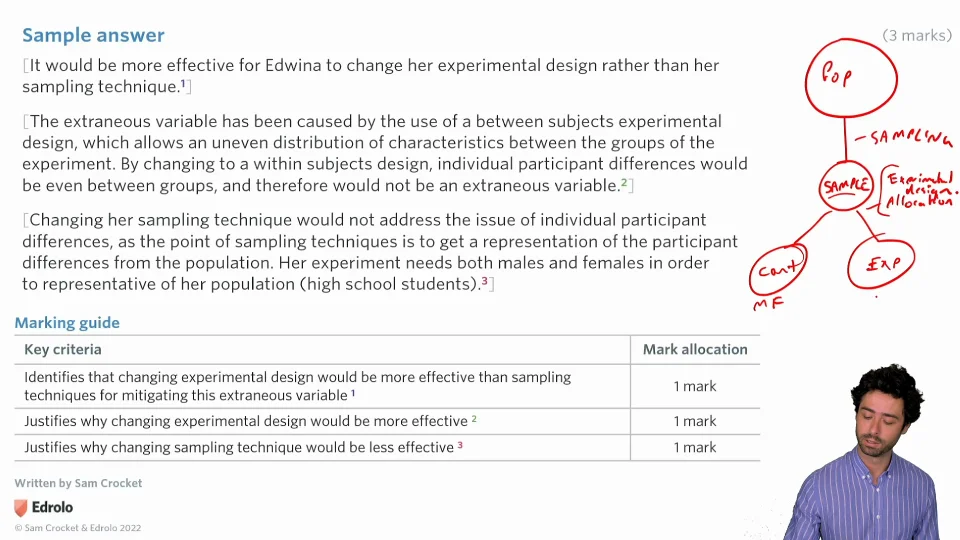
Edwina has conducted an experiment on whether exercise improves mood in high school students. When analysing the results of her experiment, she realises that an extraneous variable has affected her results. By coincidence, her control group contains more males and her experimental group contains more females. She wants to redo her experiment and try to mitigate this extraneous variable.
If Edwina was to repeat the experiment and try to control for this extraneous variable, would it be more effective for her to change her sampling technique or experimental design? Fully justify your answer.
SOLUTION
Speed: 1x
Sample answer:
[It would be more effective for Edwina to change her experimental design rather than her sampling technique.1]
[The extraneous variable has been caused by the use of a between subjects experimental design, which allows an uneven distribution of characteristics between the groups of the experiment. By changing to a within subjects design, individual participant differences would be even between groups, and therefore would not be an extraneous variable.2]
[Changing her sampling technique would not address the issue of individual participant differences, as the point of sampling techniques is to get a representation of the participant differences from the population. Her experiment needs both males and females in order to representative of her population (high school students).3]
500
Analyse the similarities and differences between method of loci used in written cultures and sung narratives used in oral culture to enhance memory. (4 marks)
2m for providing one similarity
Eg. Sung narratives in oral cultures like Aboriginal songlines require the (physical walking or) visualisation of a set of locations that act as retrieval cues for information tied to that location (such as knowledge of Country). Method of Loci as used in written cultures also requires the visualisation of a familiar path or route with locations acting as retrieval cues for information that has been ‘stored’ at each spot OR Both sung narratives such as Aboriginal songlines and method of loci involve the consolidation of memories using the hippocampus, specifically making spatial associations with new information OR Aboriginal songlines and method of loci share the characteristic of vivid, grotesque, unusual or vulgar information, activating more of the brain’s neurons and increasing the likelihood of the information being encoded and stored with more explicit detail and as a result being recalled more easily.
2m for providing one clear Difference
Eg. Method of loci in written cultures is generally used to store 1 dimension or level of knowledge for a specific purpose, such as remembering the words to a speech or essay whereas Songlines in Aboriginal culture is multidimension and the knowledge that is encoded at each location builds each time the songline is performed to layer more knowledge onto what is already known as the generations age. OR Songlines in Aboriginal culture use Country as the basis of their knowledge system involving people and their relationships with the more-than-human entities embedded within it whereas Method of loci as used in written cultures can be used to enhance memory of any information the learner wants to encode and retrieve more easily.