Intercepts
Complete the Square
Rewrite the Expression
Convert to Vertex Form
Random Review
100
Solve for the y-intercept of the function:
f(x)=2x^2+4x-7
(0,-7)
100
What number completes the square?
x^2+10x+ ?
25
100
Rewrite the expression by completing the square:
x^2-6x+5
(x-3)^2-4
100
Rewrite the equation in vertex form:
y=x^2+8x+10
y=(x+4)^2-6
100
Find the vertex:
f(x)=-3/2(x+8)^2-5
(-8,-5)
200
Solve for the x-intercept of the function:
f(x)=1/2(x+4)-5
(6,0)
200
What number completes the square?
x^2-18x+?
81
200
Rewrite the expression by completing the square:
x^2+4x-9
(x+2)^2-13
200
Rewrite the equation in vertex form:
y=x^2-10x+13
y=(x-5)^2-12
200
What is the slope of the line given?
4x+3y=18
-4/3
300
Solve for the y-intercept of the function:
f(x)=2(x-3)+7
(0,1)
300
What number completes the square?
x^2+3x+?
9/4
300
Rewrite the expression by completing the square:
x^2-2x+7
(x-1)^2+6
300
Rewrite the equation in vertex form:
y=x^2+7x
y=(x+7/2)^2-49/4
300
What is the slope of the line perpendicular to the given line?
y=3(x-2)+1
-1/3
400
Solve for the y-intercept of the function:
f(x)=2(x-3)^2+7
(0,25)
400
What number completes the square?
x^2+?x+36
12
400
Rewrite the expression by completing the square:
x^2+5x
(x+5/2)^2-25/4
400
Rewrite the equation in vertex form:
y=2x^2-8x+30
y=2(x-2)^2+22
400
What transformations happen to p(x) to produce q(x)?
p(x)=(x-1)^2+3; q(x)=-(x+3)^2+4
reflected (vertically)
translated left 4 units
translated up 1 unit
500
Solve for the x-intercept(s) of the functions:
f(x)=1/2(x+2)^2-18
(4,0), (-8,0)
500
What number completes the square?
x^2+?x+121/4
11
500
Rewrite the expression by completing the square:
2x^2+24x-3
2(x+6)^2-75
500
Rewrite the equation in vertex form:
y=(x+3)(x-1)
y=(x+1)^2-4
500
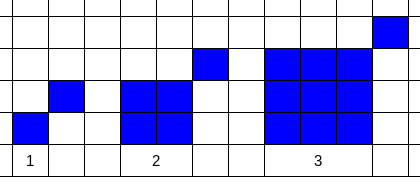
What is the function that represents this pattern?
f(x)=x^2+1