Speeding Through Matter
The "R" Words
Forces Review
Motion Review
Nature of Science
100
Unlike light, this type of wave requires a medium (matter) to travel and moves fastest through solid materials like steel.
Sound Wave
100
This phenomenon occurs when light hits a smooth, shiny surface and bounces off at the same angle it arrived.
Reflection
100
According to the Law of Gravity, every object in the universe exerts a pull on every other object based on these two factors.
Mass and Distance
100
On a distance-time graph, a perfectly straight diagonal line represents an object moving at this type of speed.
Constant Speed
100
When a student performs three trials of a sound speed experiment to ensure their own results are consistent, they are practicing this.
Repetition
200
Light waves reach their maximum speed in a vacuum but slow down significantly when they enter this state of matter, such as a glass lens or a diamond.
Solids
200
When light moves from air into a glass of water, it changes speed and bends; this process is known by this scientific term.
Refraction
200
Unlike gravity, these two at-a-distance forces have the unique ability to both push (repel) and pull (attract) other objects.
Magnetic and Electrical Forces
200
If a distance-time graph shows a horizontal (flat) line, it indicates that the object has this much speed.
Zero Speed
200
Scientists use this term to describe the measurements and observations gathered during an experiment that are used to support or refute a claim.
Data or Empirical Evidence
300
This is the relative order of sound speed from fastest to slowest through the three primary states of matter.
Solid, Liquid, Gas
300
A straw appearing "broken" or "shifted" when sitting in a half-full glass of water is a classic example of this light behavior.
Refraction
300
Friction and air resistance are examples of this general type of force, which requires two objects to physically touch each other.
Contact Force
300
This type of force is required to make a stationary object start moving or to make a moving object stop.
Decreases or Gets Weaker
300
This is a well-supported, widely accepted explanation of why light behaves the way it does, which can be changed if new evidence is found.
Scientific Theory
400
While light is the "speed demon" of the universe, it actually travels slower through this common liquid (71% of Earth) than it does through the air.
Water
400
To see your image in a mirror, light must do this twice: once off your face and once off the silvered surface of the glass.
Reflection
400
If you rub two balloons together and they begin to push away from each other without touching, they are demonstrating this type of "at-a-distance" force.
Electrical Force
400
An unbalanced force can change an object’s motion in two ways: it can change the object's speed, or it can change the object's ________.
Direction
400
While a theory explains "why," this is a statement that describes what will happen every time under certain conditions, such as the "Law of Reflection."
Scientific Law
500
In the sequence of wave speed, sound travels faster through liquids than it does through this phase of matter, but slower than it does through solids.
Gases
500
This happens to light speed specifically when it moves from a less dense medium (like air) into a more dense medium (like glass), causing it to refract.
It slows down
500
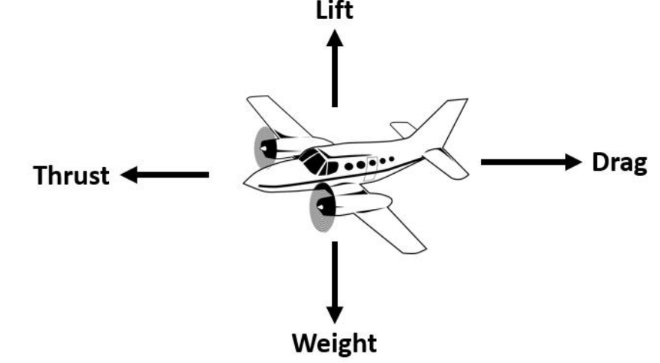
To speed up down the runway, the airplane’s engines must produce this forward-pushing force to overcome air resistance.
Thrust
500
On a distance-time graph with two straight diagonal lines, the line that is steeper represents an object that is moving with more of this.
Speed
500
To ensure an experiment on wave speed is a "fair test," a scientist must keep these factors the same, changing only the material the wave travels through.
Controlled Variable