General Wave Info
Wave Characteristics
Sound
Light
100
What is a periodic disturbance that transfers energy?
a wave
100
What is the highest point of a wave? What is the lowest point of a wave?
highest=crest
Lowest=trough
100
What causes sound waves?
vibrations
100
What type of waves are light waves?
electromagnetic
200
What does a wave transfer?
energy
200
What is the distance from a point on one wave to the same point on the next wave?
wavelength
200
What type of wave are sound waves?
longitudinal (mechanical)
200
Do infrared or microwaves have a longer wavelength?
microwaves
300
What are waves the require a medium (such as ocean)?
mechanical waves
300
What is the distance (how high or how low) particles move from the baseline of the wave?
amplitude
300
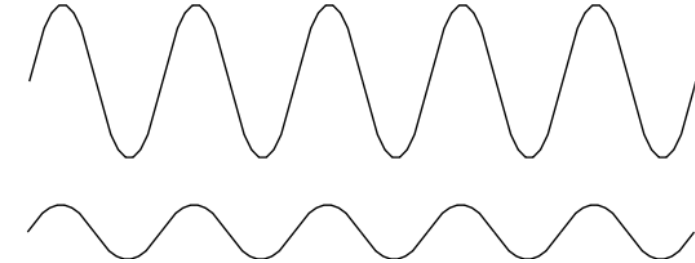 What sound wave is a person yelling? How do you know?
Top, larger amplitude=louder noise
300
What electromagnetic waves have the highest frequency?
gamma rays
400
What waves can travel through matter and empty space (ex. light waves)?
Electromagnetic waves
400
What is the number of wavelengths completed in a second?
frequency
400
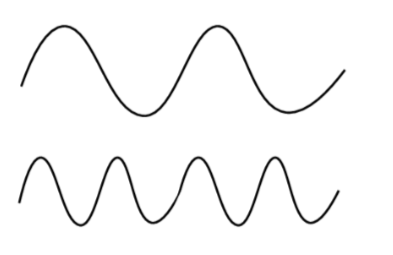 Which sound wave has a higher pitch? How do you know?
Bottom, higher frequency=higher pitch
400
Rank the following (infrared, gamma, visible, radio, X-ray, UV, and microwaves) in order of increasing frequency.
Radio, microwaves, infrared, visible, UV, X-Ray, Gamma
500
Calculate the frequencies of the following waves. Freq=wavelengths/time (t=3s)
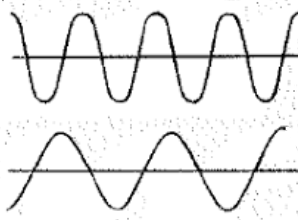
Top: F=4/2s= 2 Hz
Bottom: F=2.5/2=1.25 Hz
500
Waves with higher frequencies have (shorter, longer) wavelengths.
Waves with lower frequencies have (shorter, longer) wavelengths.
Higher freq=shorter wavelengths
Lower freq=longer wavelengths
500
Which of the following sounds would have the shortest wavelength?
Thunder at 75 Hz
A soprano singer at 2,000 Hz
A man’s voice at 500 Hz
2. A soprano singer because highest frequency=shortest frequency.
500
Give an example of each type of radiation (radio, microwaves, infrared, visible, UV, X-Ray, Gamma)
Answers vary