Global Winds
Ocean Currents
Climate Factors
Climate Graphs
Misc. Vocabulary
200
Blow from east to west near the equator
Trade winds
200
Surface currents are caused by ______
Wind
200
I
Inland
200
______________ is always the line graph
Temperature
200
Local winds that blow from land to sea are called
Land breezes
400
The global wind pattern affecting the United States
Westerlies
400
Deep ocean currents are caused by _____
Density (colder water/more salt)
400
E
Elevation
400
_____________ is always the bar graph
Precipitation
400
The reason air and ocean currents don't go in a straight line (they curve)
The Coriolis Effect
600
A fast moving band of air toward the top of the atmosphere that moves air masses
The jet stream
600
Why are warm currents mostly near the equator?
The sun hits the equator most directly causing the water to warm.
600
M
Mountains
600
True/False - the units for temperature are always degrees Celcius
False - you must look at units carefully!
600
Abnormally warm Pacific Ocean water is called
El Nino
800
The type of circulation that causes the global wind belts (hint: warm rises, cold sinks)
Convection
800
A circular pattern of surface ocean currents are called
Gyres
800
L
Latitude
800
Climate graphs can show us that cities on the same latitude can have _____________ climates.
Different
800
The ____________ effect explains why one side of the mountain can be wet while the other is dry
Rain Shadow
1000
An area near the equator that gets almost no wind and so sailboats can get stuck there.
The doldrums
1000
What causes Florida to be warmer and more humid than California?
The Gulf Stream is a Warm Current compared to the California Current which is cold and therefore more warm/moist air will be on the East Coast.
1000
C (must give 2 answers)
Air and ocean currents
1000
The average precipitation for October is _______
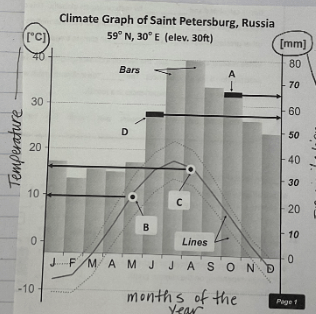
66 mm
1000
A worldwide system of surface and deep ocean currents that move water all around the globe is called the
Global Conveyor Belt