Upper Extremity
Head Neck and Spine
Lower Extremity
Clinical Applicaton
Emergency Management
100
Name the four rotator cuff muscles?
What are the supraspinatus, the infraspinatus, the teres major/minor, and the subscapularis?
100
What are the Maddox questions?
1. What venue are we at today?
2. Which half is it now?
3. Who scored last in this match?
4. Which team did you play last week/game?
5. Did your team win the last game?
100
What are the Ottawa Ankle Rules?
1. TTP on malleolar zone or posterior edge tip of medial/lateral malleous (6 cm)
2. Unable to weight bear post injury and unable to take 4 steps
3. Pain in midfoot zone
4. TTP @ base of 5th metatarsal or navicular
100
This part of your objective assessment could inform you largely how the patient moves in the moment (please remember to do them!)
Functional test/evaluation/assessment
100
What is the appropriate breath-to-compression ratio for CPR?
What is 30:2?
200
Name 4 articulation sites (joints) in the upper extremity
What are the glenohumeral, humeroradial/humeroulnar, the metacarpophalangeal, the acromioclavicular (AC) joint, or the sternoclavicular (SC) joints?
200
What is the normative range for lumbar lateral flexion
What is "15-20º"?
200
What are the 3 special tests for IT band, and what makes a (+) for each?
Ober's: (+) leg failing to drop, staying still
Nobles: (+) for pain at around 30 deg flexion
Rennes: (+) pain at lateral epicondyle
200
Ouch!!! One of your patients just sustained a laceration while playing lacrosse. Bleeding has been controlled, but there is significant dirt in the middle of the wound. You decided to clean first before proceeding further. What direction should you clean the wound?
From the middle of the wound to the outside
200
According to the NATA, how often should the EAP be reviewed?
What is "at least annually"?
300
Which muscles are the synergists along with the biceps brachii?
What are the brachioradialis, and brachialis?
300
Which cranial nerves are sensory only?
What are 1,2, & 8?
300
What is one way to instantly relief the symptoms of subungal hematoma by releasing the built-up pressure?
What is cauterization?
300
Name three principles that could increase the difficulty and/or complexity of a rehab exercise.
Manipulation/ Body transport/ Open environment/ Inter-trial variability
300
Name at least three crucial aspects of the crutch fitting process.
- 6 inches in front (anteriorly)
- 2 inches out (laterally)
- Underarm brace should be 2-3 finger widths
- Arm flexion of 30 deg
- Neutral wrist position
400
Which bone, whose posterior aspect of its lateral 1/3, does the upper trapezius insert into?
What is the clavicle?
400
How many different types of Le Fort fractures are there? Name them + key characteristics
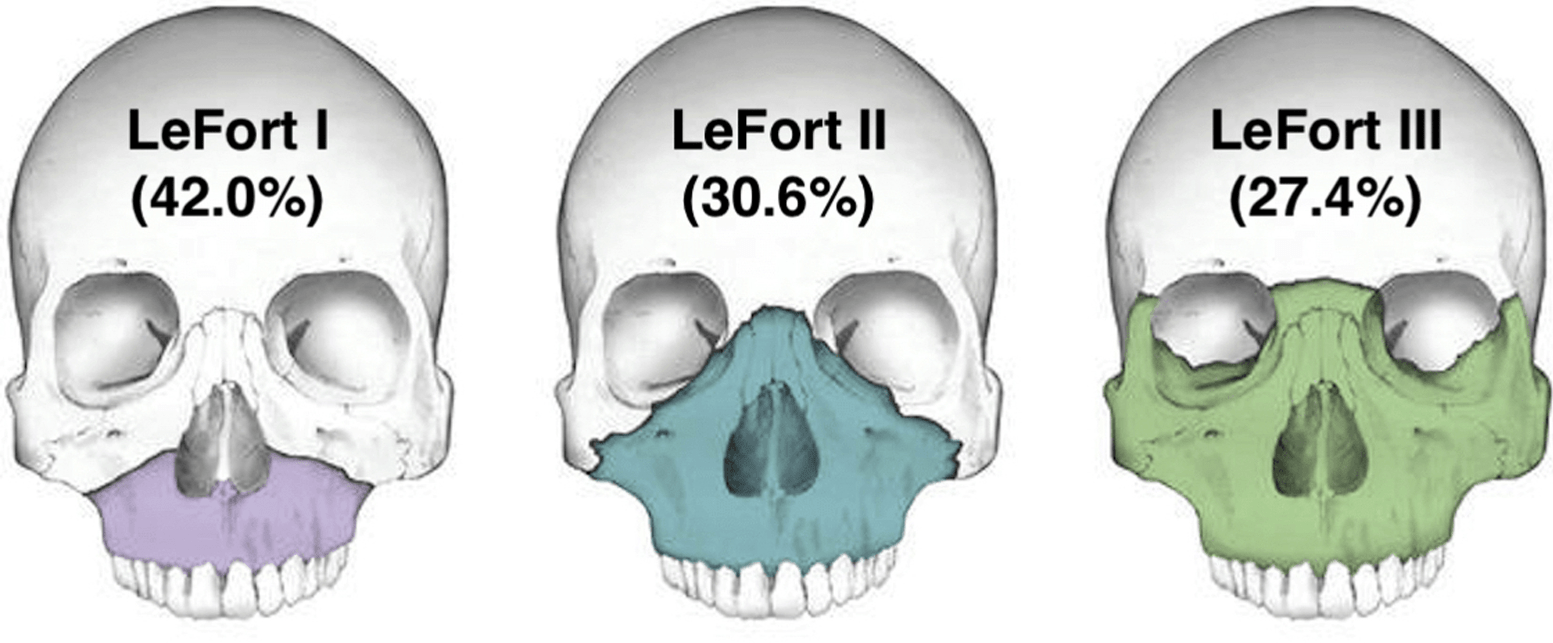 Le Fort 1
Low. Separates upper teeth/alveolar ridge from the rest of the face
Le Fort 2
Extends from nasal bridge → maxilla → infraorbital rim. Pyramid shaped fracture involving central midface
Le Fort 3
Across the orbits and nasal bridge, separates the entire midface from the skull. “Floating face”
400
What is considered the "keystone" of the medial longitudinal arch of the foot?
What is the navicular?
400
Open tibia fracture. These are the steps that you should manage before relaying transportation to the EMS crew.
(Cover with towel as needed)
1. Control bleeding
2. Assess neurological functions
3. Splint (preferably vacuum)
400
What 5 pieces of information should be provided to EMS on the phone?
1. Name of caller (address/telephone)
2. Number of athletes involved
3. Condition of the athlete
4. Treatment initiated
5. Specific directions to the emergency scene
500
A patient has difficulty gripping due to impaired finger flexion. Which myotome (nerve root) is affected?
What is C8?
500
What are the Canadian C-Spine rules (at least one from each of the three steps)?
Step 1: High-Risk Factors (→ image if ANY are present)
Age ≥ 65 years
Dangerous mechanism of injury (e.g., fall from height, high-speed MVC, axial load to head)
Paresthesias in extremities
Step 2: Low-Risk Factors (→ allow safe assessment of motion)
If none of the high-risk factors are present, check for low-risk factors that allow evaluation:
Simple rear-end motor vehicle collision
Sitting position in the ED
Ambulatory at any time after injury
Delayed onset of neck pain (not immediate)
No midline cervical spine tenderness
Step 3: Neck Rotation
If at least one low-risk factor is present, assess active neck rotation
If the patient can rotate their neck 45° left and right, no imaging is needed
If unable to rotate 45°, imaging is required
500
Name the 4 compartments of the lower leg, and name at least 1 muscle from each?
Anterior Compartment: Tibialis anterior, extensor hallucis longus, extensor digitorum longus,
Lateral Compartment: peroneus longus, brevis, peroneus tertius
Superficial Posterior: gastrocnemius, soleus, plantaris
Deep posterior: Flexor hallucis longus, flexor digitorum longus, and tibialis posterior
500
One of your patients has a history of neurodivergence due to their ADHD diagnosis, and they struggle with keeping 100% attention during rehab sessions. What is one of the many possible ways that you can adapt the facility environment?
1. Concise and direct feedback/cue
2. 1-on-1 direct attention to minimize distractions from the rest of the facility
3. Gamification increase focus
4. Quieter separate area to minimize distractions
4. Bottom line: Ask the patient for recommendations
500
This is the leading cause of preventable death in high school athletics.
What is exertional heat stroke?