I'm all broken up
I can't move
This is twisted
I'm usually so stiff
There's a hole in the bucket, Dear Liza
100
This fracture type is almost always associated with child abuse
Spiral
100
Developmentally speaking, the immobilized child is at greatest risk for
Regression
100
The most common cause of scoliosis is
idiopathic
100
The most common type of cerebral palsy is
Spastic
100
This defect is incompatible with life
Anencephaly
200
While performing a neurovascular check on a child with a cast on his arm, you note cold, blue fingers, capillary fill time of 7 seconds and weak pulses. What is the appropriate action for you to take
This child needs immediate orthopedic evaluation with likely cast removal
200
Physiologically, juvenile idiopathic arthritis involves
Chronic inflammation of synovium with joint effusion, destruction of cartilage, and ankylosis of joints as disease progresses
200
What is the correct method to screen for scoliosis
Bending forward to touch toes, evaluate hip and scapula height as well as palpate for curvature
200
The most common causes of cerebral palsy are
Any perinatal or neonatal brain lesion or brain maldevelopment, regardless of the cause, may be linked to as many as 80% of the total cases of CP
Prematurity is highly associated
200
immediate management of a child with a myelomeningocele will include
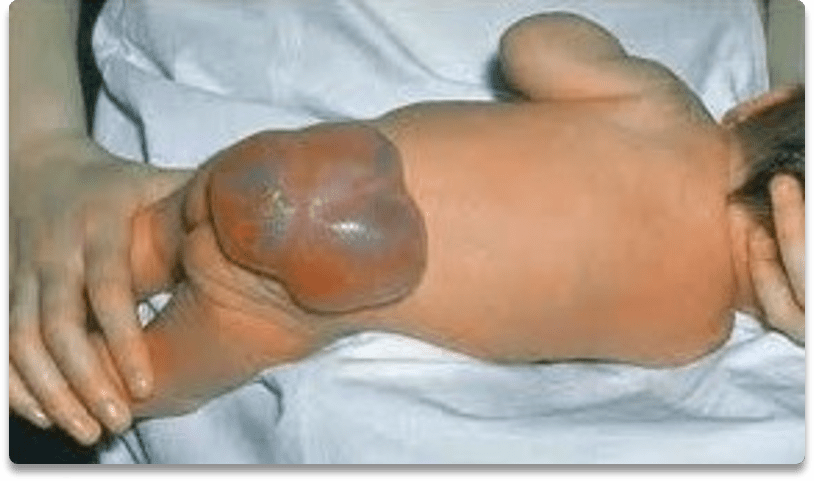
warm sterile saline soaked gauze to defect
cover with sterile saran wrap
300
Describe nursing measures to decrease fear in a 5-year-old child prior to cast removal
cast saw can be put against your own skin
cast saw can be used on a stuffed animal
child can be given an important job, such as holding something for you
300
Signs of JIA include (name 5)
Stiffness
Swelling
Loss of mobility in affected joints
Warm to touch
Tenderness
Growth retardation
Symptoms worsen with stress
300
What is the primary concern for an adolescent with scoliosis
body image
300
Early signs of cerebral palsy
Floppy tone (earliest)
Hypertonicity
back arching
Clenched fists after 3 months
unable to sit without support at 8 months
No smiling by 3 months
Feeding difficulty
excessive irritability
300
All children with myelomeningocele have these associated findings (2)
Hydrocephalus
Latex allergy
400
Appropriate management of a child in a cast will include
Pulses, CRT, skin color, and temperature
Palpation of cast for hot spots
Alleviate pressure on nerves, treat pain
Compartment syndrome
Promote nutrition and hydration
Support growth and development
Support family system
400
The primary goals of treatment for JIA are (3)
Preserve function
Prevent deformities
Relieve symptoms
400
When and how should an infant be screen for developmental displasia of the hip
At birth with Ortolani and Barlow maneuvers
400
Goals of therapy for cerebral palsy are
Establish locomotion, communication, and self-help
Gain optimum integration of motor functions
Correct associated defects as early and effectively as possible
Provide educational opportunities
Promote socialization experiences
500
Pin care and management of skeletal traction will include:
inspection of pin sites for signs of infection
cleansing of sites as ordered
Ensure weights hang freely off the edge of the bed and never rest on the floor or the bed frame -DO NOT ADJUST OR REMOVE TRACTION
500
Children with spinal cord injuries as well as myelominingoceles are prone to autonomic dysreflexia. What signs can we see (name 5)
increased BP
headache
bradycardia
profuse diaphoresis
cardiac arrhythmias
flushing
piloerection
blurred vision
nasal congestion
anxiety
visual spots
500
Describe the management of an infant in a Pavlik harness
It must be worn for 23-24 hours per day for 6-12 weeks
Straps are to be adjusted everey 1-2 weeks by physician ONLY
Inspect the skin 2 to 3 times daily for redness or breakdown under the straps.
The infant should wear a soft undershirt and knee-high socks under the harness to prevent the straps from rubbing directly against bare skin.
Always place the diaper under the straps.
Avoid using lotions or powders beneath the device, as they can cake, trap moisture, and lead to skin maceration.
600
Diagnosis of Duchenne's muscular dystrophy is made by:
Suspected based on clinical appearance
Confirmation by EMG, muscle biopsy, and serum enzyme measurement
Serum CPK and AST levels high in first two years of life, before onset of weakness; levels diminish as muscle deterioration continues