Sympathetic vs parasympathetic
Neuro across the lifespan
Men's health
Renal disorders
renal system
100
Select the drugs below that are considered anticholinergic drugs (also called parasympatholytic):
A. Pyridostigmine
B. Atropine
C. Ipratropium
D. Propranolol
Answers:
B: atropine
C: ipratropium
100
- Which space within the meningeal layers contains cerebrospinal fluid (CSF)?
A. subdural space
B. epidural space
C. subarachnoid space
D. epiarachnoid space
C: subarachnoid space
100
The dual function of the testes is:
Answer: spermatogenesis & secretion of testosterone
100
- You're assessing your patients during morning rounding. Which patient below is at MOST risk for developing a urinary tract infection?*
- A. A 25 year old patient who finished a regime of antibiotics for strep throat 10 weeks ago.
- B. A 55 year old female who is post-opt day 7 from hip surgery.
- C. A 68 year old male who is experiencing nausea and vomiting.
- D. A 87 year old female with Alzheimer’s disease who is experiencing bowel incontinence.
D: A 87 year old female with Alzheimer’s disease who is experiencing bowel incontinence.
100
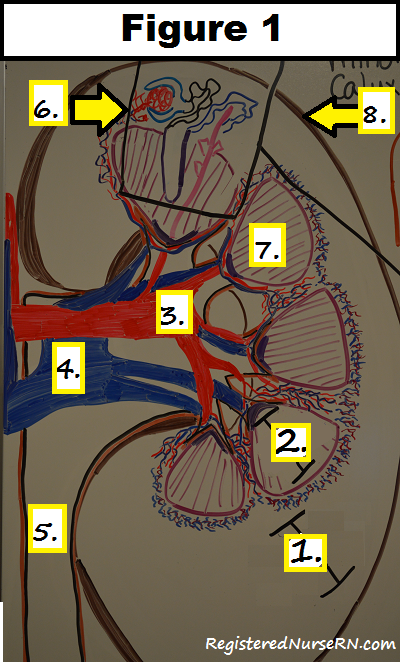
n Figure 1, what areas are labeled as Number 1 and 2?
A. Number 1: Renal Medulla; Number 2: Renal Cortex
B. Number 1: Renal Cortex; Number 2: Renal Medulla
C. Number 1: Renal Capsule; Number 2: Minor Calyx
D. Number 1: Minor Calyx; Number 2: Major Calyx
B:
Number 1: Renal Cortex; Number 2: Renal Medulla
200
The postganglionic neuron releases what neurotransmitter in the parasympathetic nervous system?
A. Arginine
B. Norepinephrine
C. Dopamine
D. Acetylcholine
D: Acetylcholine
200
You are assessing a patient with suspected meningitis. When the patient is placed in the supine position with the hips and knees flexed at 90 degrees, extending the knee causes pain and resistance. This finding is documented as a positive __ sign.
A. Cullen’s
B. McBurney’s
C. Brudzinski’s
D. Kernig’s
D. Kernig's
200
This screening is used to screen for prostate cancer and is recommended annually for men older than _____.
Name the screening and the age
Digital rectal exam & older than 50 years old.
200
A 36 year old female, who is 29 weeks pregnant, reports she is experiencing burning when voiding. The physician orders a urinalysis. Which statement by the patient demonstrates she understands how to collect the specimen?
A. “I’ll hold the cup firmly against the urethra while collecting the sample.”
B. “I will cleanse back to front with the antiseptic wipe before peeing in the cup.”
C. “First, I will pee a small amount of urine in the toilet and then collect the rest in the cup.”
D. “I will be sure to drink a lot of fluids to keep the urine diluted before peeing into the cup.”
C. “First, I will pee a small amount of urine in the toilet and then collect the rest in the cup.”
200
the functional part of the kidney is known as the ________ and is displayed as number 6 in Figure 1.
A. Renal Pyramid
B. Renal Pelvis
C. Nephron
D. Collecting ducts
C: nephron
300
In the sympathetic nervous system ganglia are found? Select all that apply:
A. Thoracic
B. Brain stem
C. Sacral
D. Lumbar
Answers: A- Thoracic; D- Lumbar
300
n early stages of Alzheimer’s disease, the hippocampus is affected. This part of the brain is responsible for what function(s)? Select all that apply:
- A. Learning
- B. Navigation
- C. Memory
- D. Language
- E. Planning
Answer: A- Learning; B- Navigation, & C- Memory
300
DRE and PSA testing are important screening procedures because abnormal DRE and elevated PSA may raise suspicion of prostate cancer. however, a diagnosis of cancer requires this:
Prostate biopsy
300
A patient, who is having spasms and burning while urinating due to a UTI, is prescribed “Pyridium” (Phenazopyridine). Which option below is a normal side effect of this drug?
A. Hematuria
B. Crystalluria
C. Urethra mucous
D. Orange colored urine
D: orange colored urine
300
The renal medulla’s environment is ___________ which plays a vital role (with the help of the nephron) in maintaining the water and salt balance in the body.
A. Isotonic
B. Hypotonic
C. Hypertonic
D. Hyper/hypotonic
C: hypertonic
400
The sympathetic nervous system postganglionic neuron releases what neurotransmitter?
A. Acetylcholine
B. Norepinephrine
C. Both Acetylcholine and Norepinephrine
D. Arginine
B: norepinephrine
400
Select the main structures below that play a role with altering intracranial pressure:
A. Brain
B. Neurons
C. Cerebrospinal Fluid
D. Blood
E. Periosteum
F. Dura mater
Answers: A- Brain; C- Cerebrospinal fluid; D- blood
400
pharmacologic treatments for BPH include:
Name the class of medications
Answer: Alpha adrenergic blockers & 5- alpha reductase inhibitors
400
A 55 year old male patient is diagnosed with chronic kidney disease. The patient’s recent GFR was 25 mL/min. What stage of chronic kidney disease is this known as?
A. Stage 1
B. Stage 3
C. Stage 4
D. Stage 5
C: stage 4
400
The structure that takes blood flow to the glomerulus for filtration is known as the ______________.
A. Efferent arteriole
B. Renal vein
C. Peritubular capillaries
D. Afferent arteriole
D: Afferent arteriole
500
Select all the signs and symptoms a patient can experience with the stimulation of the sympathetic nervous system: Select all that apply:
A. Tachycardia
B. Hypotension
C. Hyperglycemia
D. Dilated pupils
E. Urinary incontinence
F. Bronchodilation
G. Cold and clammy
H. Excessive salivation
I. Sweating
Answers:
A: tachycardia
C: hyperglycemia
D: Dilated pupils
F: bronchodilation
I: Sweating
500
You’re providing education to a group of nursing students about ICP. You explain that when cerebral perfusion pressure falls too low the brain is not properly perfused and brain tissue dies. A student asks, “What is a normal cerebral perfusion pressure level?” Your response is:
A. 5-15 mmHg
B. 60-100 mmHg
C. 30-45 mmHg
D. >160 mmHg
B: 60-100 mmHg
500
this is the first line therapy for treating erectile dysfunction
Phosphodiesterase type 5 (PDE-5) inhibitors
500
Your patient with chronic kidney disease is scheduled for dialysis in the morning. While examining the patient’s telemetry strip, you note tall peaked T-waves. You notify the physician who orders a STAT basic metabolic panel (BMP). What result from the BMP confirms the EKG abnormality?
A. Phosphate 3.2 mg/dL
B. Calcium 9.3 mg/dL
C. Magnesium 2.2 mg/dL
D. Potassium 7.1 mEq/L
D; Potassium 7.1
500
what is the correct order in how the urine flows out of the kidney once it leaves the nephron (collecting duct)?
A. Renal papilla, minor calyx, major calyx, renal pelvis, ureter, bladder, urethra
B. Minor calyx, major calyx, renal papilla, renal pelvis, ureter, bladder, urethra
C. Renal papilla, renal pelvis, minor calyx, major calyx, ureter, bladder, urethra
D. Renal papilla, major calyx, minor calyx, renal pelvis, ureter, bladder, urethra
Answer: A. Renal papilla, minor calyx, major calyx, renal pelvis, ureter, bladder, urethra