Archaeology
Geography & Migration
Paleolithic Life
Neolithic Life
Neolthic Settlements & Sites
What is this?
100
This person studies the past by examining artifacts, human remains, settlements, and other physical evidence.
Archaeologist
100
Early humans often moved from place to place because they needed to find these three basic resources.
Food, Water, & Shelter
100
This type of society relied on hunting animals and gathering wild plants for food.
Hunter-Gatherer Society
100
This major development allowed humans to intentionally grow plants for food.
Agriculture
100
This famous prehistoric structure is located in England.
Stonehenge
100
Does this picture most represent a Paleolithic Society or a Neolithic Society?
Neolithic (farming/agriculture)
200
A stone spearhead, a piece of pottery, or a tool made by humans would all be examples of this type of historical evidence.
Artifact
200
Early humans were most likely to settle near which geographic feature because it provided an important resource for survival?
A. A river
B. A mountain peak
C. A dry desert
D. A frozen tundra
A. A River
200
Paleolithic people generally had this type of lifestyle because they moved to follow available resources.
Nomadic Lifestyle
200
When humans tame animals and raise them for their own purposes, this process is called what?
Domestication
200
This Neolithic settlement, located in modern-day Turkey, is one of the early settlements studied by archaeologists. It is currently still being studied.
Çatalhöyük
200
What neolithic settlement is this?
Stonehenge (England)
300
Archaeologists can use this scientific method to help determine the age of organic material.
Carbon Dating
300
Why did early humans often move to different areas?
A.They wanted to establish governments.
B. They wanted to build larger cities.
C. They were searching for places to build factories.
D. They were looking for better sources of food and water.
D. They were looking for better sources of food and water.
300
Early humans lived in small groups connected by family relationships. What were these groups called?
Clans
300
Why did farming make it possible for some humans to stop constantly moving from place to place?
Farming allowed people to produce food in one location and they no longer had to follow animals/sources of food.
300
This fertile region around the Tigris and Euphrates Rivers supported early settlements and agriculture.
Fertile Crescent
300
What is the definition of prehistory?
The time before written language
400
Archaeologists find the remains of a prehistoric campsite. Which piece of evidence would provide the BEST information about the tools early humans used?
A. Animal bones
B. Stone tools
C. Cave paintings
D. Seeds and plant remains
B. Stone Tools
400
Which geographic factor would have been MOST important to a hunter-gatherer group deciding where to live?
A. The presence of roads
B. The location of large buildings
C. The availability of food and water
D. The availability of metal coins
C. The availability of food and water
400
Name two important developments associated with Paleolithic humans.
Simple stone tools, fire, oral language, cave art, hunting, or gathering
400
Which change would most likely happen as a result of agriculture: increased migration or the development of permanent settlements?
Development of permanent settlements
400
Name one early Neolithic settlement in the Fertile Crescent that archaeologists have studied.
Jericho or Aleppo
400
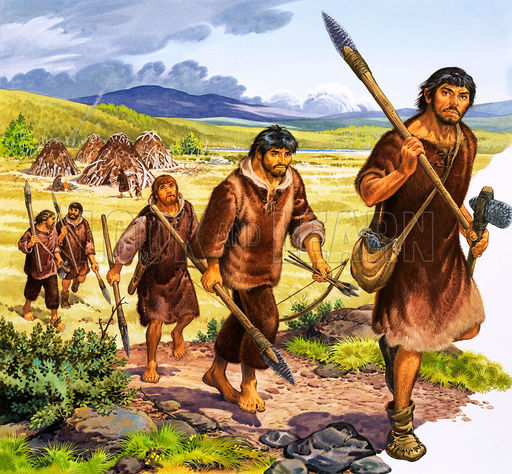
What era does this picture best depict?
Paleolithic Era (Hunting & Gathering)
500
Archaeologists discover a cave containing paintings of animals and human figures. What can these paintings help historians understand?
A. The exact number of people who lived in the area
B. The names of the people who created the paintings
C. Some of the activities and beliefs of prehistoric people
D. The exact date that humans first arrived in Africa
C. Some of the activities and beliefs of prehistoric people
500
Which statement BEST explains how geography affected early human societies?
A. Geography had little effect because humans could produce all of their own food.
B. Early humans adapted their movements and ways of life to the resources available in their environment.
C. Geography only affected where early humans built monuments.
D. Early humans always remained in the same location regardless of environmental conditions.
B. Early humans adapted their movements and ways of life to the resources available in their environment.
500
A group lives in small clans, hunts animals, gathers wild plants, makes simple tools, and moves when food becomes scarce. Which era does this group most closely represent?
Paleolithic Era
500
Which two technologies or skills became important in Neolithic societies as people began living in permanent settlements?
A. Pottery and weaving
B. Writing and currency
C. Ironworking and shipbuilding
D. Gunpowder and paper
A. Pottery and weaving
500
Archaeologists discover a settlement containing permanent homes, pottery, farming tools, domesticated animal remains, and evidence of weaving. Is this evidence more consistent with a Paleolithic or Neolithic society?
Neolithic Era, because the evidence shows agriculture, domestication, permanent settlement, pottery, and weaving
500
What is another name for Paleolithic Era and Neolithic Era?
Old Stone Age
New Stone Age