Fundamental Astronomy
Space Missions
Pioneers
Cosmic Phenomena
Space Vocabulary
200
A lunar eclipse occurs when which celestial body moves directly between the Sun and the Moon?
Earth
200
What NASA mission successfully carried the first humans to the surface of the Moon in 1969?
Apollo 11
200
Who is this astronaut, and what major accomplishment is he known for?
Neil Armstrong was the first human to walk on the Moon.
200
What colorful sky glow occurs when charged particles from the Sun interact with Earth’s magnetic field?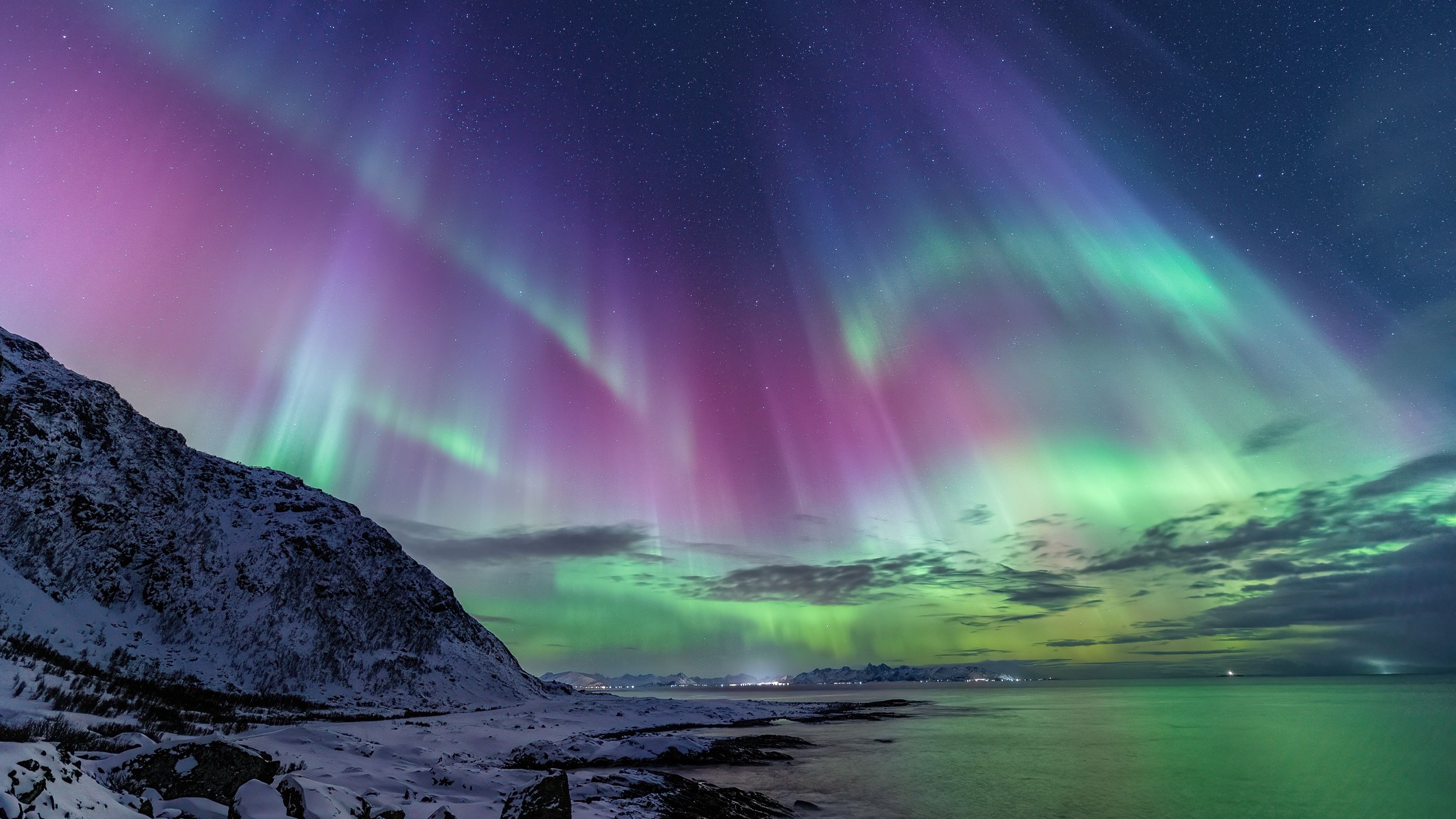
Aurora
200
What force pulls objects toward each other and keeps planets circling the Sun?
Gravity
400
What is the average distance from Earth to the Moon?
~384,400 km
400
Which spacecraft became the first human‑made object to enter interstellar space?
Voyager 1
400
Who became the first human to travel into space and orbit Earth in 1961?
Yuri Gagarin
400
What icy objects develop glowing tails when they approach the Sun?
Comets
400
What term measures distance in space based on how far light travels in one year?
A light‑year
600
What type of eclipse is shown in this image?
Total solar eclipse
600
Which rover landed on Mars in 2012 and used a sky‑crane for touchdown?
Curiosity
600
Which physicist developed the theory of general relativity, fundamentally changing our understanding of gravity?
Albert Einstein
600
 What massive clouds of gas and dust serve as the birthplaces of new stars?
Nebulae
600
What unit of measurement equals the average distance between Earth and the Sun?
Astronomical Unit (AU)
800
Name this moon phase
Waning gibbous
800
What orbiting laboratory has been continuously inhabited since 2000 and serves as a joint project between multiple nations?
The International Space Station
800
Who became the first American woman to travel into space in 1983?
Sally Ride
800
What powerful explosion marks the death of a massive star and can briefly outshine an entire galaxy?
A supernova
800
What technique analyzes light to determine the composition of stars and planets?
Spectroscopy
1000
What is the difference between a solar day and a sidereal day?
A solar day is ~24 hours (Sun returns to the same position), while a sidereal day is ~23 hours 56 minutes (Earth’s rotation relative to distant stars).
1000
What NASA spacecraft, launched in 1972, became the first to travel through the asteroid belt and make a close‑up flyby of Jupiter before heading toward interstellar space?
Pioneer 10
1000
Who became the first African American woman to travel into space in 1992?
Mae Jemison
1000
What cosmic phenomenon forms when a massive star collapses under its own gravity, creating a region where not even light can escape?
A black hole
1000
What effect describes the change in a light wave’s wavelength caused by an object’s physical motion through space, making approaching stars appear blueshifted and receding stars appear redshifted?
The Doppler Effect