Likelihood
Expected Value
Prob Trees
Conditional Probability
100
An event has a probability of 0. What is its likelihood?
Impossible
100
You flip a coin. Win $10 for heads, $0 for tails. What is the expected value?
A: $5
100
In a tree diagram, how do you calculate the probability along a branch?
A: Multiply the probabilities
200
You roll a fair die. What is the likelihood of rolling a number greater than 4?
A: Unlikely (2 out of 6 = 1/3)
200
A game gives you $20 with probability 0.25 and loses you $4 otherwise. Expected value?
EV = (0.25)(20) + (0.75)(-4) = 5 - 3 = $2
200
A coin is flipped twice. What is the probability of getting HH?
A:
(1/2)(1/2) = 1/4
300
A card is chosen from a deck. What is the probability it is red? Describe the likelihood.
A: 1/2, equally likely
300
A game has expected value of $0. What kind of game is this?
A: A fair game
300
A test is 90% accurate. 10% of people have a disease. What is the probability someone has the disease AND tests positive?
A:
0.10 × 0.90 = 0.09 (9%)
300
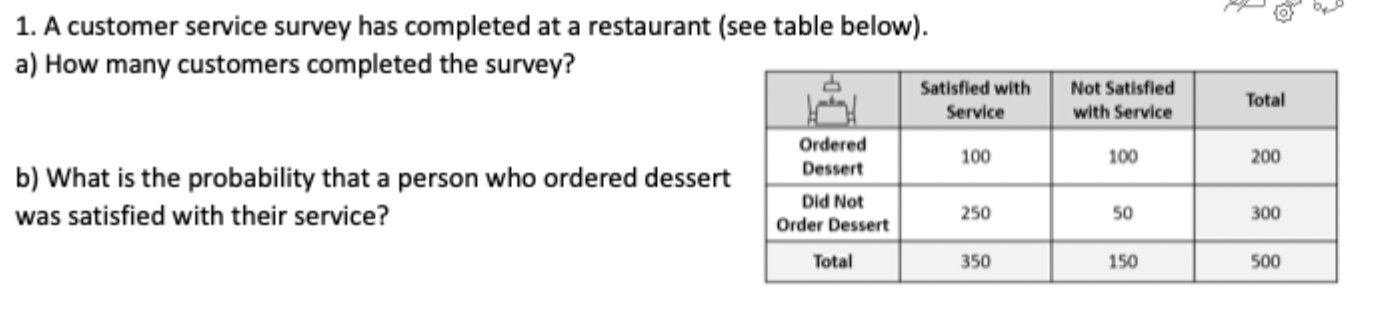
a) 500 people
b) 250/300 = 0.833333 = 83.33%
400
Give an example of an event that is “likely” but not “certain.”
A: Example: rolling a number less than 6 on a die (5/6)
400
A game costs $5 to play. You win $15 with probability 0.3. Find expected value.
A:
EV = (0.3)(15) + (0.7)(0) - 5
= 4.5 - 5 = -$0.50
400
In a correctly drawn tree diagram, what should all end probabilities add up to?
A: 1 (or 100%)
400
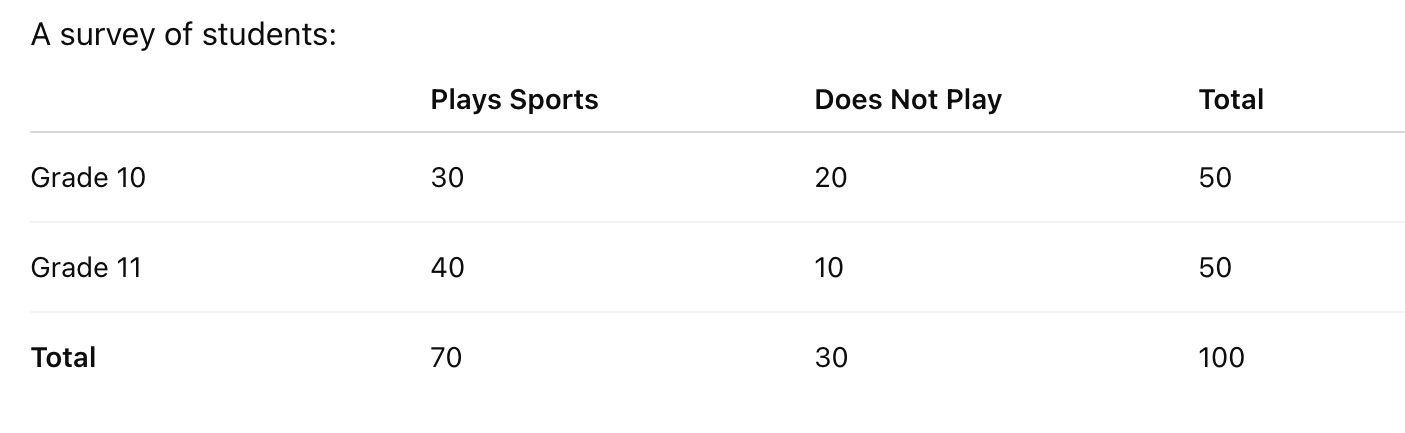
What is P(Grade 11 | plays sports)?
40 / 70 = 0.571 (57.1%)
500
Two dice are rolled. The sum is greater than 2. Describe the likelihood.
A: Very likely (only one outcome is not: 1+1)
500
Q:
A company sells a laptop warranty for $120.
There is a 15% chance the laptop will need repairs, and the average repair cost is $500.
a) What is the expected value for the customer?
b) What is the expected profit for the company?
a) Customer expected value:
EV = (0.15)(500) + (0.85)(0) − 120
EV = 75 − 120 = −$45
b) Company expected value:
EV = 120 − 75 = +$45
500
A product has 5% defect rate. 80% of defects are caught. What is the probability a product is defective AND caught?
A:
0.05 × 0.80 = 0.04 (4%)
500
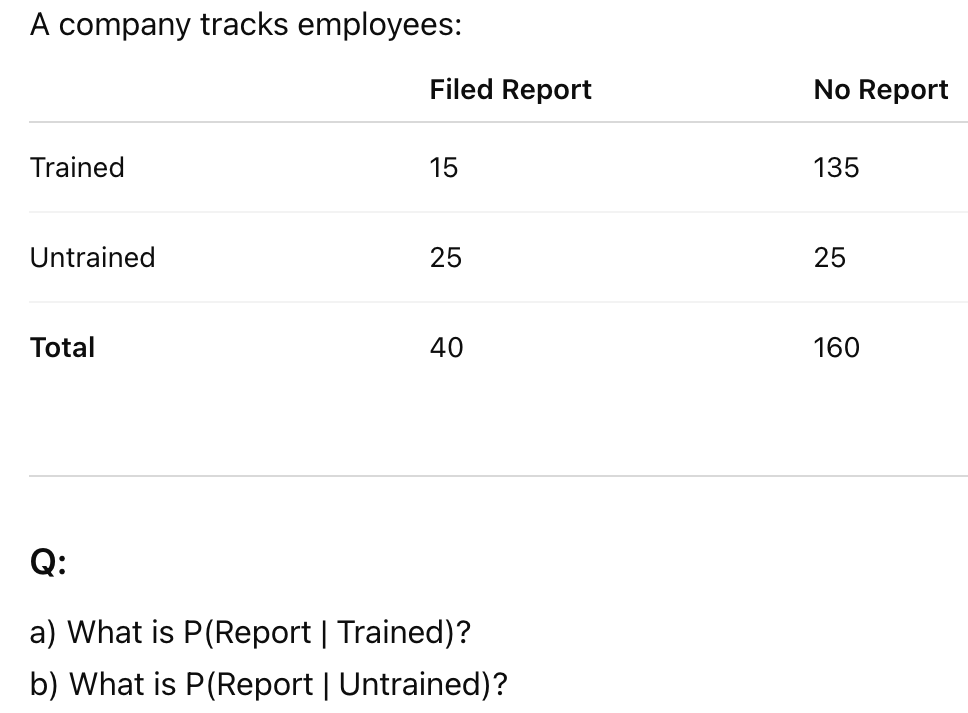
a) 15 / 150 = 0.10 (10%)
b) 25 / 50 = 0.50 (50%)