Let's get Wavey
Exchanging 'Parts'
There's Levels to it
This place is a bit Quarky
I'm sure it's just a phase (difference)
100
The process of waves spreading out through a gap upon meeting one that is of the same order of magnitude as their wavelength
What is diffraction?
100
This particle mediates electromagnetic interactions between charged particles.
What is a photon?
100
The minimum energy an electron can be in an atom.
What is the ground state?
100
The quark composition of a proton and a neutron.
What are uud (proton) and udd (neutron)?
100
The phase difference, in radians, represented by the image below, causing two waves to completely cancel out at all points.
What is pi radians?
200
Total internal reflection can only occur if this property of a material is lower than the one the wave is currently in.
What is refractive index?
200
This exchange particle causes matter to decay by changing the flavour of a particle. Beta decay and electron capture, for example?
What is the W boson?
200
If an electron reaches energy level n = infinity, about 13.6 eV in hydrogen, this process will happen.
What is ionisation / ionise?
200
The composition of any meson is always this 'destructive' pairing
What is a quark-antiquark pair?
200
The path difference that corresponds to two waves being completely in phase with each other.
What is nλ? (A whole number of wavelengths)
300
These are points on a stationary wave where the phase difference between the two oncoming waves is always π radians.
What are nodes?
300
While gluons carry the strong interaction between individual quarks, it is these composite particles that transfer the strong force between the nucleons themselves.
What are pions?
300
The amount of unique photons that could be released from a de-excitation from n=4 to the ground state.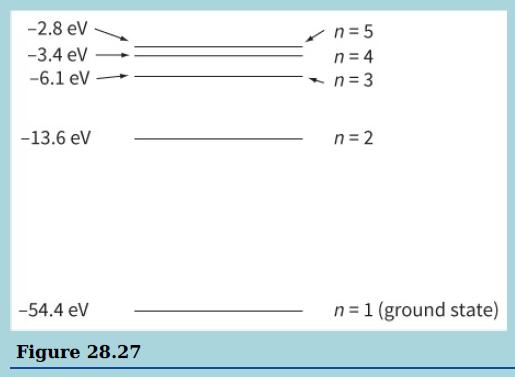
What is six?
300
The difference in mass-energy between the products and the reactants when colliding hadrons together is usually released as this.
What is Kinetic Energy?
300
Two waves that have the same frequency, wavelength and have a constant phase difference over time are known as this.
What is coherent?
400
Assuming the light source is kept at the same distance away from a screen and the same light is used, decreasing this variable will increase the spacing between bright fringes in a double slit pattern
What is slit width?
400
Of all the exchange particles, this one is the most divisive since it has never been observed!
What is a graviton?
400
The name of this characteristic spectrum produced by each element when its atoms de-excite, releasing photons of visible light.
What is an emission spectrum?
400
Under the weak interaction, Kaons can decay into pions. In particular, it is this quark that changes flavour.
What is a strange (or antistrange) quark?
400
The phase difference represented by this image below, in radians.
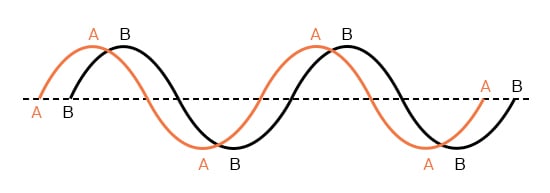
What is pi/4? (45 degrees)
500
This phenomenon occurs when a pulse of light sent through an optical fibre appears to spread out due to the difference in path lengths
What is modal dispersion?
500
In the decay of a muon, an electron, an antielectron neutrino and this particle are produced when the muon releases a W- boson.
What is a muon neutrino?
500
This process sees a low pressure vapour become excited by electron collisions, de-excite to release UV photons, and then have them absorbed by a special coating, exciting their atoms. The atoms de-excite in stages, releasing visible light.
This can sometimes be directly induced by shining UV light directly on certain rocks!
What is fluorescence?
500
In this impossible weak interaction:
K+ + K+ → p + p̄ + π+
This rule is not being followed.
What is "strangeness only changing by 1, -1 or 0 in weak interactions"?
500
The total path difference between points on a wave going through a diffraction grating when looking at the third order minimum.
What is 7λ/2?