Rights & Freedoms - General
Rights and Freedoms - Australia
Sources
Rights and Freedoms - USA
UDHR
100
This policy forced Aboriginal people to give up their culture to be accepted into white society.
What is assimilation
100
This was the legislation that gave the Aborigines Protection Board authority to remove Aboriginal children from their families without a court order
The Aborigines Protection Amending Act 1915
100
 What concept does this image show?
Segregation.
100
Which US civil rights leader’s speeches inspired activists worldwide, including in Australia?
Martin Luther King Jr.
100
This year marks the adoption of the Universal Declaration of Human Rights by the United Nations General Assembly.
1948
200
Name one major cultural impact of the Stolen Generations.
Loss of language, cultural knowledge, and identity.
200
This is the Latin term was used by the British to justify the occupation of Australia
Terra Nullius
200
Identify 3 impacts of the Stolen Generations
Lasting trauma by severing Indigenous peoples' connections to family, culture, and land, leading to deep intergenerational disadvantages that persist today.
200
The codified system of state and local statutes, primarily in the American South from the 1880s to the 1960s, that enforced rigid racial segregation and disenfranchisement against Black Americans
Jim Crow laws
200
This person chaired the committee that drafted the UDHR.
Who is Eleanor Roosevelt?
300
What was the goal of the assimilation policy introduced in Australia in the 1950s?
To absorb Aboriginal people into white society by encouraging them to adopt Western culture and values.
300
This date marks the arrival of the First Fleet and the beginning of British occupation
January 26 1788
300
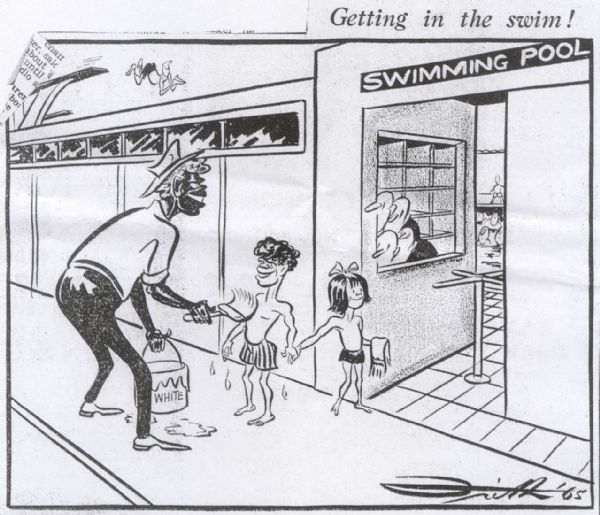 What is the motive of this cartoon?
To show the public what the expectations were for the Aboriginal people using the Moree pools.
300
Name one key method used by civil rights activists in the US to bring about change.
Peaceful protests, sit-ins, Freedom Rides, legal challenges.
300
This was Australia's representative for the drafting of the Universal Declaration of Human Rights
Who is Dr Herbert Evatt
400
Who led the 1965 Freedom Ride in Australia?
Charles Perkins
400
What was one goal of the Freedom Ride?
To expose racial discrimination in rural NSW towns.
400
A newspaper article from 1963 calls the March on Washington 'unrealistic and disruptive.' What might this tell you about the author’s perspective?
The author likely opposed the movement or held conservative views about social change.
400
How did the US Freedom Rides inspire Aboriginal activists in Australia?
They demonstrated peaceful protest methods to challenge racial discrimination, leading to the 1965 NSW Freedom Ride.
400
What is the purpose behind the creation of the UDHR
To establish the basic human rights and freedoms afforded to all people
500
What two changes occurred due to the 1967 Referendum?
Aboriginal people were counted in the census and the federal government could make laws for them.
500
This was the first major event of Indigenous activism which drew attention to the poor treatment of Aboriginal people and entrenched racial discrimination
What is the 1938 Day of Mourning
500
What does S.A.F.A stand for?
Student Action for Aborigines
500
Why was Emmett Till’s mother, Mamie Till-Mobley, significant in raising awareness of racial injustice?
She insisted on an open-casket funeral so the world could see what racism had done to her son, fuelling national outrage.
500
This article of the UDHR states that everyone has the right to life, liberty, and security of person.
What is Article 3
600
This was the first attempt in history to lay out rights and freedoms
The Cyrus Cylinder
600
List THREE reasons given for removal of Indigenous children in NSW
- 'being Aboriginal'
- 'being 14 years'
- 'at risk of immorality'
- 'neglected'
- 'to get her away from surroundings of Aboriginal station/Removal from idle reserve life'
- 'Orphan'
- 'to send to service'
600
What is the significance of Little Rock Nine?
Direct test of Brown v Board of Education, showing the federal government's commitment to enforcing the desegregation of schools
600
Place these events in order: March on Washington, Freedom Rides, Civil Rights Act signed.
Freedom Rides (1961) → March on Washington (1963) → Civil Rights Act (1964).
600
What is one of the two legally binding covenants inspired by the UDHR?
What is the International Covenant on Civil and Political Rights and International Covenant on Economic, Social and Cultural Rights