Reading to Write
Narratives that Shape our World
Critical Study of Literature
Literature
Name the novel
100
The name of the poem we studied first in this focus area
What is 'England in 1819'?
100
The composers of the core texts we studied.
William Shakespeare and Ryan Griffen
100
The poet we are studying in this focus area.
Robert Browning
100
This term describes language that creates vivid sensory pictures in the reader's mind, used extensively in poetry and prose
What is Imagery
100
"Mr and Mrs Dursley, of number four, Privet Drive, were proud to say that they were perfectly normal, thank you very much." This beloved novel introduces a boy who discovers he is a wizard.
What is Harry Potter and the Philosopher's Stone (by J.K. Rowling)?
200
The name of the Peter Carey imaginative text we studied
What is 'Report on the Shadow Industry'?
200
The years in which The Tempest and Cleverman (TV Series) were released.
When is 1611 and 2016
200
The name of Robert Browning's wife
Who was Elizabeth Barret (Browning)
200
This narrative technique places the reader inside a character's flowing thoughts and perceptions, as seen in the works of Virginia Woolf.
What is stream of consciousness?
200
"You may tell yourself: I am not the story." In this dystopian novel, women are stripped of their identities and forced into reproductive servitude under a theocratic regime.
What is The Handmaid's Tale (by Margaret Atwood)?
300
The different text types we learned/revise to write in this focus area.
Imaginative
Discursive
Persuasive
Reflective (creative reflection and analytical reflection)
300
The character who said this:
'When they will not give a doit to relieve a lame beggar, they will lay out ten to see a dead indian.'
Who is Trincule
300
The reigning monarch during Browning's life.
Who was Queen Victoria?
300
In Greek tragedy, this fatal character flaw leads the protagonist to their downfall — Oedipus's pride is a classic example.
What is hamartia (fatal flaw)
300
"It was a bright cold day in April, and the clocks were striking thirteen." This dystopian novel imagines a totalitarian society under the watch of Big Brother.
What is Nineteen Eighty-Four (by Orwell)?
400
The techniques used in this quote: We heard a howl. We heard a howl of humiliation that echoes across two centuries of dispossession, injustice, suffering and survival. We heard the howl of the Australian dream and it said to us again, you’re not welcome.
You must name at least 2 correct terms
Anadiplosis
Anaphora
Alliteration
Emotive language
Personification
Metaphor
400
The name and correct spelling of the dog-like monster in Cleverman.
What is the namorrodor.
400
The titles of TWO of Browning's poems that we'll study.
What are:
Porphyria's Lover
My Last Duchess
The Laboratory
Soliloquy of the Spanish Cloister
400
This 19th century literary movement celebrated nature, individual emotion, and the imagination as a reaction against industrialisation and rationalism — William Blake and Percy Bysshe Shelley are key figures.
What is Romanticism?
400
"I, the miserable and the abandoned, am an abortion, to be spurned at, and kicked, and trampled on." These words, spoken by the creature himself, come from this Gothic novel that questions what it means to be human.
What is Frankenstein (by Mary Shelley)?
500
The meaning of the following persuasive techniques:
Pathos
Logos
Ethos
Kairos
Topos
Telos
Pathos- emotional appeal
Logos- appeal to logic
Ethos- the credibility of the argument/speaker
Kairos- the timeliness of the argument
Topos- the key idea/theme of the argument
Telos- the purpose of the argument
500
These are three stages of the hero's journey.
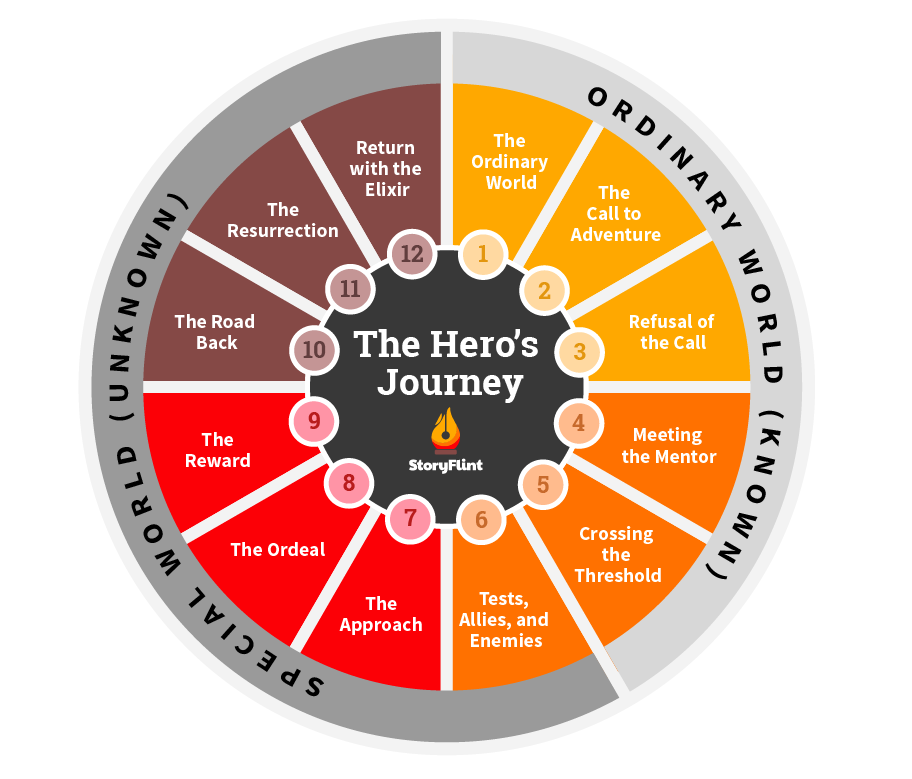
500
The key conventions of a Dramatic Monologue. Use the SPIN acronym to remind you.
Silent audience
Psychological portraiture
Implicit narrative
Narrated in first person
500
This term, coined by Russian theorist Mikhail Bakhtin, describes a text that incorporates multiple distinct voices or perspectives, none of which is dominant.
What is polyphony (or dialogism)?
500
Both Frankenstein and The Handmaid's Tale use this narrative technique, in which the story is presented as a discovered document or testimony, raising questions about truth, reliability, and who controls the telling.
What is a frame narrative (or epistolary/found document narrative)?