Plant Diversity
Plant Anatomy
Primary and Secondary growth in Plants
Soil and Plant Nutrients
Resource aquisition and Transport in Plants
100
Which group of plants does NOT have vascular tissue?
A. Ferns
B. Gymnosperms
C. Mosses
D. Angiosperms
C. mosses
100
Which of the following lists the three basic plant organs correctly?
A. Roots, flowers, fruits
B. Roots, stems, leaves
C. Leaves, xylem, phloem
D. Stems, epidermis, ground tissue
B. Roots, stems, leabes
100
TRUE OR FALSE:
Primary growth occurs in ALL plants
Secondary growth occurs in ALL plants
Primary growth occurs in ALL plants - TRUE
Secondary growth occurs in ALL plants - FALSE
100
what are the two basic properties of soil?
Texture and composition
100
Which transport pathway moves substances through the cytosol and plasmodesmata of plant cells?
A. Apoplastic pathway
B. Symplastic pathway
C. Transmembrane pathway
D. Cohesion pathway
B. Symplastic pathway
Explanation:
apoplastic – external to the cell membrane
symplastic – via the cytosol of the cell (requires entry into 1 cell, then can move via plasmodesmata)
200
The dominant life stage in non-vascular plants (bryophytes) is the ______________ generation.
gametophyte
200
The two main vascular tissues in plants are __________ and __________.
xylem and phloem
200
Which meristem is primarily responsible for secondary growth in plants?
A. Apical meristem
B. Ground meristem
C. Lateral meristem
D. Protoderm
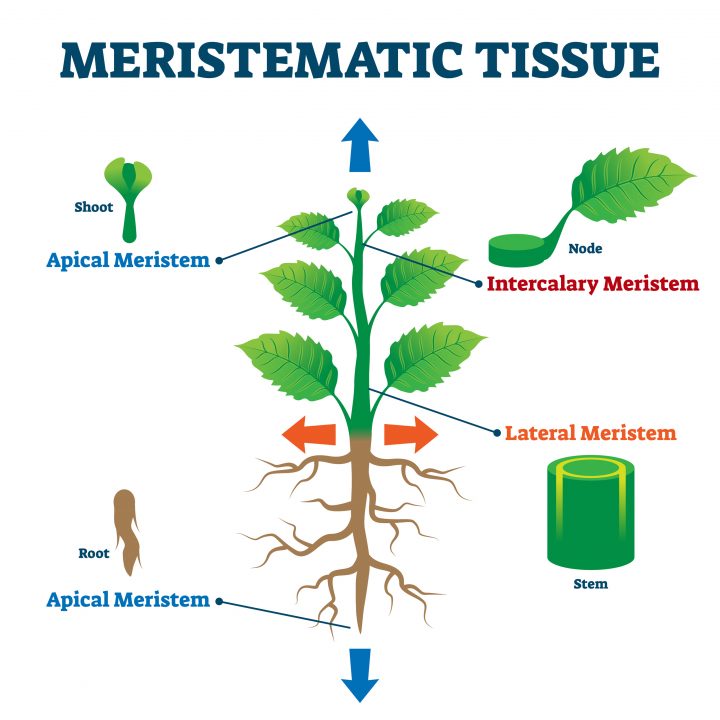
C. Lateral meristem
200
__________________________ are beneficial, symbiotic fungi that colonize plant roots.
Mycorrhizae
200
The movement of water through a selectively permeable membrane from an area of higher water potential to lower water potential is called __________________________.
Osmosis
300
what are two adaptations that allowed plants to successfully colonise land
- Protection of gametes and embryos (e.g., archegonium, antheridium, embryo retained in parent plant)
- Waxy cuticle to reduce water loss
- Stomata for gas exchange
- Apical meristems for growth above/below ground
- Tough spores with sporopollenin to resist drying
300
What are two main functions of roots in plants
- Anchors the plant in the soil
- Absorbs water
- Absorbs minerals
- Stores carbohydrates and energy reserves
300
The layer of cells in roots that regulates the movement of substances into the vascular tissue is called the __________________________.
Endodermis
Vascular cylinder – solid core of xylem and phloem. Surrounded by root endodermis: layer of cell between ground tissue and vascular tissue. Forms a barrier to regulate passage of substances from soil to vascular tissue
300
Describe each soil horizon: (3)
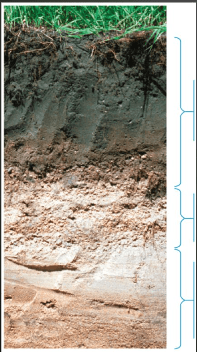
Horizon A: Topsoil. Consists of mineral particles (broken-down rock of various textures), living organisms and humus (decaying organic material)
Horizon B: Less organic matter, less weathered
Horizon C: Partially broken-down rocks
300
State and explain the three short-distance transport pathways in plants:
apoplastic – external to the cell membrane
symplastic – via the cytosol of the cell (requires entry into 1 cell, then can move via plasmodesmata)
transmembrane – between cells across the cell membrane (repeated crossing)
400
Match the plant group to its correct characteristic:
- Mosses
- Ferns
- Gymnosperms
- Angiosperms
a. Seeds enclosed in fruit
b. Dominant sporophyte with vascular tissue
c. Gametophyte-dominant life cycle
d. Naked seeds (cones)
- Mosses = c (gametophyte-dominant life cycle)
- Ferns = b (dominant sporophyte with vascular tissue)
- Gymnosperms = d (naked seeds in cones)
- Angiosperms = a (seeds enclosed in fruit)
400
Match the plant type to its correct root or leaf characteristic:
- Monocots
- Eudicots
a. Parallel leaf veins
b. Branching leaf veins
c. Fibrous root system
d. Taproot system
- Monocots = a, c (parallel veins, fibrous root system)
- Eudicots = b, d (branching veins, taproot system)
400
Compare primary growth and secondary growth in plants.
- where does each type of growth occur?
- What type of meristem involved?
1. Primary Growth -
- Occurs at the tips of roots and shoots.
- Produced by apical meristems.
2. Secondary Growth (thickness) -
- Occurs in older regions of stems and roots (areas other that tips), especially in woody plants.
- Produced by lateral meristems
400
Label each particle type and rate its water retention and oxygenation as: ‘good’ or ‘medium’ or ‘poor’
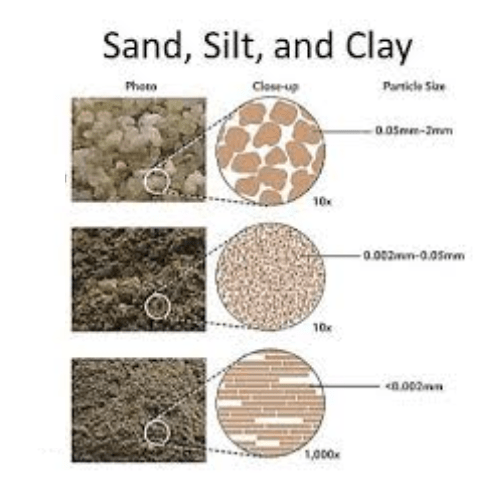
Sand: Water retention = poor. Oxygenation = Good.
Silt: Water retention = Medium. Oxygenation = Medium.
Clay: Water retention = Good. Oxygenation = Poor.
400
Explain how water potential (Ψ) influences water movement in plant cells.
Water potential (Ψ) determines the direction water moves by osmosis. Water moves from areas of higher water potential to lower water potential.
500
Explain why seedless vascular plants (e.g., ferns) were more evolutionarily successful than bryophytes (non-vascular).
- Have vascular tissue (xylem and phloem) → allows transport of water and nutrients
- Can grow larger and taller due to structural support from lignin in xylem
- Have a dominant sporophyte stage (more complex and long-lived)
- Have true roots and leaves, increasing absorption and photosynthesis efficiency
- More successful at competing for sunlight and dispersing spores over longer distances
500
Label this diagram (top to bottom)
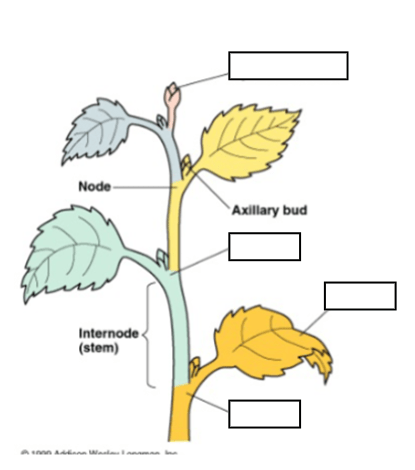
Apical meristem
node
leaf
node
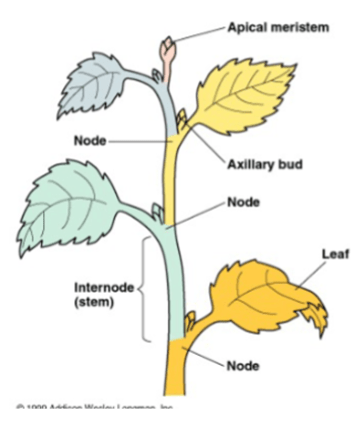
500
Describe the three zones involved in primary growth of roots
Zone of cell division: stem cells (apical meristem) and their immediate products
Zone of elongation: where new cells elongate (up to 10x their original length) 🡪 pushes root tip further down
Zone of differentiation (or maturation): cells complete differentiation, become distinct cell types

500
define Macronutrients and Micronutrients, and list at least 3 of each that plants need. (3 macronutrients and 3 micronutrients)
Macronutrients = Macronutrient: essential elements plants need in relatively large quantities. Examples: carbon, oxygen, hydrogen, nitrogen,
phosphorus, sulphur
Micronutrients = essential elements plants need in relatively small amounts (often cofactors). Examples: chlorine, iron, manganese, boron, zinc, copper, nickel, molybdenum
500
Describe the cohesion–tension hypothesis for the movement of water through xylem.
The cohesion–tension hypothesis explains how water moves upward through xylem.
Water evaporates from leaf surfaces during transpiration. This creates negative pressure (tension) in the leaf. 
600
Compare gymnosperms and angiosperms by stating:
- One key difference in reproduction
- One advantage angiosperms have over gymnosperms in modern ecosystems
- Difference in reproduction:
- Gymnosperms: seeds are naked (cones), no flowers or fruit. wind fertilisation.
- Angiosperms: seeds are enclosed in fruit and produced in flowers (double fertilisation) - animal transport mainly
- Advantage of angiosperms:
- More efficient pollination and seed dispersal (often animal-assisted via flowers and fruits)
- Allows greater reproductive success and colonisation of diverse habitat
600
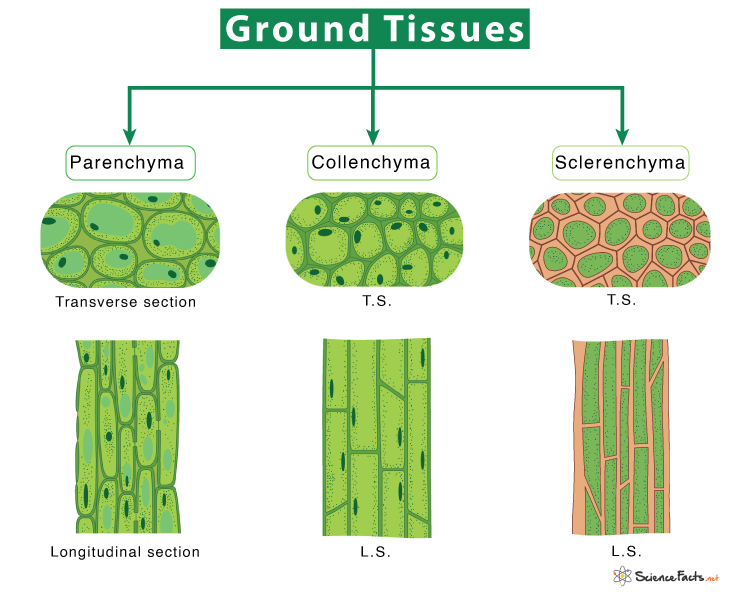
There are 3 types of cells in ground tissues. Name them
600
Label the following structures
- Secondary phloem
- Vascular cambium
- Secondary xylem
- Pith
- Cork cambium
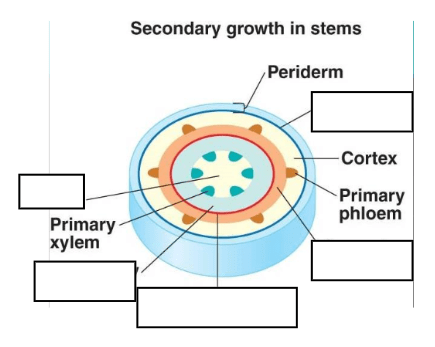
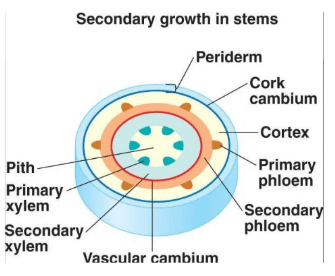
- Cork cambium
- Lateral meristem that produces cork outward and phelloderm inward; responsible for bark formation.
- Secondary phloem
- Transports sugars (photosynthates) from leaves to other parts of the plant.
- Vascular cambium
- Thin cylinder of dividing cells; produces secondary phloem outward and secondary xylem inward.
- Secondary xylem (wood)
- Transports water/minerals upward and provides structural support; forms annual growth rings.
- Pith
- Central ground tissue, mainly parenchyma; storage and internal support in young stems.
600
name 4 methods of controlling erosion
Planting trees (windbreaker, root stabilisation)
Terracing hillside crops (levels)
Cultivating in a contour pattern (not straight)
Practicing no-till agriculture (growing crops from year to year without disturbing the soil) completely eliminated soil erosion
600
In angiosperms, phloem sap flows in sieve-tube elements. By what two methods does sap move through the plant?
Active transport and Bulk flow (positive pressure)