1
2
3
4
5
100
John B Watson
Established Behaviourism
Conducted Little Albert
100
Zimbardo
He had to build a simulation on a prison, 24 participants were allocated 2 roles prisoner or guard.
Ended early on day 6, after a graduate student complained, saying they were showing severe anxiety
The guards took full advantage of their role
100
The Pygmalion Effect
Higher expectations placed upon individuals lead to an increase in their performance.
100
Festinger
Social comparison Theory - We evaluate ourselves based on comparisons and competition with outer people
Upward Comparison: Compare self to someone of higher standards
Downward Comparison: Compare self to someone of lower standards
Lateral Comparison: Compare self to someone we view to be on an equal level
100
Te tiriti o Waitangi principles
Partnership | Pātuitanga: The Crown and Māori acting reasonably and in good faith to create a strong, enduring, and respectful relationship.
Participation | Whakauru: The right of Māori to participate in society, including decision-making and government processes.
Protection | Whakamarumarutia: Active protection of Māori interests, rights, culture, and taonga (treasured things)
200
Sternberg's Triangular Theory of Love
love is composed of three interconnected components: intimacy (closeness), passion (physical attraction), and commitment (decision to remain together).
Different combinations of these three elements produce eight distinct types of love, with "consummate love" (possessing all three) considered the ideal form
:max_bytes(150000):strip_icc()/Triangular-Theory-of-Love-1-2000-81eda9a1c9a848ecb3a769fa1004c6ac.jpg)
200
Lewin, Lippitt & White, 1939 - Founders of leadership styles
Founders of leadership styles
1. Authoritarian Leadership
This style of leadership is strongly focused on both command by the leader and control of the followers. There is also a clear division between the leader and the members.
Researchers found that decision-making was less creative under authoritarian leadership.
2. Participative Leadership
Democratic leaders offer guidance to group members, but they also participate in the group and allow input from other group members. In Lewin’s study, children in this group were less productive than the members of the authoritarian group, but their contributions were of a higher quality.
3. Delegative Leadership
Delegative leaders offer little or no guidance to group members and leave decision-making up to group members. While this style can be useful in situations involving highly qualified experts, it often leads to poorly defined roles and a lack of motivation.
However, this style of leadership may be effective in teams that are:
• Motivated
• Highly skilled
• Knowledgeable
200
Social Power
This is the ability of a person to create conformity even when the people being influenced may attempt to resist those changes
E.g.
Managers
200
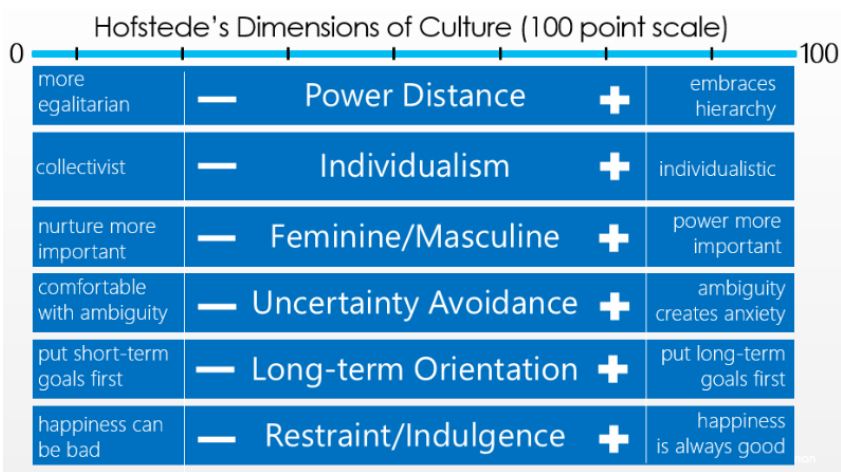
Hofstede’s cultural dimensions
- Power Distance Index: Measures the extent to which less powerful members accept unequal power distribution. High PDI cultures (e.g., Malaysia) respect strict hierarchy and absolute authority. Low PDI cultures (e.g., New Zealand) value egalitarianism and consultative leadership.
- Individualism vs. Collectivism: Examines the degree of societal interdependence. Individualistic societies (e.g., United States) focus on personal goals and immediate family. Collectivist societies (e.g., Guatemala) prioritize group loyalty and community cohesion.
- Motivation toward Achievement and Success: Historically called Masculinity vs. Femininity. High achievement cultures focus on competition, ambition, and material success. Low achievement (or nurturing) cultures emphasize quality of life, relationship building, and consensus.
- Uncertainty Avoidance Index: Rates how comfortable a society is with ambiguity and the unknown. High UAI cultures (e.g., Greece) use strict laws, structured rules, and rigid religious guidelines to control anxiety. Low UAI cultures are more adaptable, relaxed, and open to changing rules. [1, 2, 3]
- Long-Term vs. Short-Term Orientation: Added later to evaluate how cultures balance future challenges with historical traditions. Long-term cultures (e.g., China) value persistence, thrift, and pragmatic adaptation. Short-term cultures focus on rapid results, national pride, and fulfilling immediate social obligations.
- Indulgence vs. Restraint: Gauges a society's capability to fulfill basic human desires. Indulgents (e.g., Mexico) prize leisure time, personal freedom, and immediate emotional gratification. Restrained cultures suppress impulse gratification through strict moral standards and social norms.
200
Kaupapa Māori Principles

300
Carl Jung
introducing concepts like
introversion and extroversion
The collective unconscious - a universal, inherited layer of the unconscious mind
Archetypes - universal, inborn models of personalities and behaviours
300
Functionalism
focuses why the mind works rather than just its structure
300
Walster & Berscheid - Computer Date experiment
participants asked how much they'd like to go out again, the researchers found...
The found that true love found you need passionate love and companionate love
passionate love (intense, physiological arousal)
companionate love (deep friendship and attachment).
They proposed that passionate love requires high arousal, while companionate love thrives on equity and long-term commitment
300
Carl Rogers
Founded the humanistic approach to psychology and developing client-centred (or person-centred) therapy
300
Pavlov
Conditional behaviours/Classical conditioning - learning where an automatic, involuntary reflex response becomes paired with a new, neutral stimulus
400
Mary Ainsworth
Attachment theory
The strange situation
Procedure to measure attachment styles between infants and caregivers.
Her research identified key attachment patterns—secure, avoidant, and resistant/ambivalent
400
Heterogeneity
It is often possible to meet DSM criteria while having very different sets of symptoms. This is called symptomatic heterogeneity’
400
Behaviourism Theory
All behaviour is learned through the environment
400
Social Facilitation - Tripplett
performance increases when in competition with others
400
OCEAN
- O - Openness to Experience: Reflects creativity, curiosity, and a willingness to try new things.
- C - Conscientiousness: Reflects self-control, orderliness, responsibility, and goal-directed behavior.
- E - Extraversion: Measures how much an individual is energized by social interaction and external stimulation.
- A - Agreeableness: Represents a tendency toward compassion, cooperation, and social harmony.
- N - Neuroticism: Reflects emotional stability and the tendency to experience negative emotions such as anxiety or irritability
500
Harry Harlow's Monkey Attachment
Investigated attachment and the affectional bond between an infant and its mother.
Cloth Mother vs. Wire Mother
Harlow (1958) separated infant monkeys from their mothers immediately after birth and placed in cages with access to two surrogate mothers, one made of wire and one covered in soft terry toweling cloth.
In one condition, only the wire mother provided food via an attached milk bottle; the cloth mother offered comfort alone. In a second condition, the cloth mother provided the milk.
Both groups of monkeys spent more time with the cloth mother (even if she had no milk). The infant would only go to the wire mother when hungry.
Once fed it would return to the cloth mother for most of the day. If a frightening object was placed in the cage the infant took refuge with the cloth mother (its safe base)
500
Transdiagnostic Mechanisms
is a chunk of a theory/explanation, that seems to apply across different problems/diagnoses
500
Descriptive vs Causal
Descriptive approaches distinguish based on observable features
Causal approaches distinguish based on some underlying cause of the groupings
500
Christina Maslach
Researched Burnout
500
Milgram
The shock experiment
62.5% Continued to administer shocks at the highest level
368 volts was the average shock level administered past the point of implied mutism due to damage.
In the original study they couldn't see the victim but this wasn't the only experiment conducted.
Milgram found that there was an identical rate of obedience which was 65%