Phases of Mitosis
Mitosis Vocabulary
Stages of Interphase
Big Ideas
AP Past Questions
100
What are the 4 phases of mitosis in order?
Prophase, Metaphase, Anaphase, Telophase
100
Centromere
A specialized condensed region of each chromosome that appears during mitosis where the chromatids are held together to form an X shape (the middle part)
100
Mitosis is sometimes referred to as? (What phase)
M phase
100
What happens if a cell loses the ability to control its growth rate?
Cancer
100
A mouse skin cell containing \[40\] chromosomes undergoes mitosis. This process results in the formation of
Choose 1 answer:
- Afour daughter nuclei, each with 40 chromosomes
- Bfour daughter nuclei, each with 20 chromosomeschromosomes
- Ctwo daughter nuclei, each with 40 chromosomes
- Dtwo daughter nuclei, each with 20 chromosomes
- Ctwo daughter nuclei, each with 40 chromosomes
200
Name the phase: Cell organelles start to re-build and the newly-formed daughter cells begin to take shape for their own interphase. Nuclear envelopes develop around the genetic material at each pole, the chromosomes unwind and return to loosely-floating chromatin, and the nucleoli appear once more
Telophase
200
Karyotype
The appearance of the chromosomal makeup of a somatic cell in an individual or species
200
What is the G0 phase?
When a cell exits the active cell cycle and doesn’t prepare to divide, either permanent or temporary
200
Why does DNA replication occur before mitosis begins?
So that each daughter cell can have a complete and identical set of chromosomes during mitosis.
200
The image below depicts a somatic cell nucleus before DNA replication:
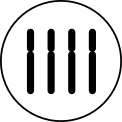
If the cell undergoes mitosis, which of the following correctly depicts the daughter nuclei that would result?
- A
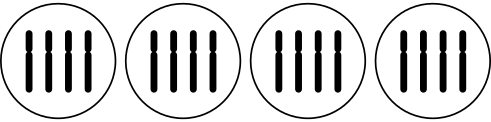
B
B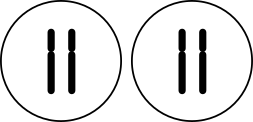
C
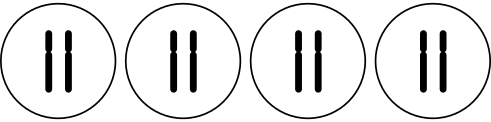
D —. NONE OF THE ABOVE
None of the above.
There would be two identical daughter cells.
300
During metaphase, the fully-formed chromosomes are aligned by the microtubules at the center of the cell in a plane known as?
The metaphase plate
300
Cleavage Furrow
the first sign of cytokinesis during cell division in an animal cell; a shallow groove in the cell surface near the old metaphase plate
300
What does the “S” stand for in the “S-Phase” and what happens during this phase (Hint: DNA) ?
Synthesis phase, DNA is duplicated
300
A cell exposed to a chemical that prevents spindle fiber formation enters mitosis. Predict which stage will be disrupted and how.
Metaphase will be disrupted because spindle fibers cannot attach to kinetochores, which will prevent proper alignment and separation of sister chromatids.
300
A student is examining an onion root tip cell under a microscope. Based on her observations, the student proposes that the onion root tip cell has completed interphase and is now in the first phase of mitosis.
Which of the following pieces of evidence would best support the student’s claim?
Choose 1 answer:
- AThe cell’s DNA is dispersed within the nucleus as chromatin.
- BSeparated sister chromatids are being pulled towards opposite ends of the cell.
- CDiscrete chromosomes are scattered throughout the cell’s nucleus.
- DThe cell’s chromosomes are aligned across the metaphase plate.
- CDiscrete chromosomes are scattered throughout the cell’s nucleus.
400
Which phase features the formation of mitotic spindle fibers?
Prophase
400
Cytokinesis
The final stage of the cell cycle, in which the cell's cytoplasm divides, distributing the organelles into each of the two new cells.
400
Which phase results in many of the organelles and molecules required for cell division being produced?
G2 phase
400
How to cell cycle checkpoints regulate mitosis?
They monitor DNA integrity and spindle attachment by preventing progression of damaged DNA, which reduces mutations.
400
In response to critically low nutrient levels, yeast cells often enter into a dormant, non-dividing state. This state allows yeast cells to survive until nutrient levels are restored, at which point the cells typically re-enter the cell cycle.
According to the information above, critically low nutrient levels cause yeast cells to
Choose 1 answer:
- Atransition into mitosis
- Btransition from G0 to G1 phase
- Ctransition into meiosis
- Dtransition from G1 to G0 phase
D. Transition from G1 to G0 phase
500
Name the phase: The split chromatids are pulled to the poles of the cell via the shortening of the microtubules. At the end of this phase, each pole contains a complete set of identical chromosomes
Anaphase
500
Density-dependent Inhibition
The phenomenon observed in normal animal cells that causes them to stop dividing when they come into contact with one another.
500
What is the other name for the G0 phase? (Hint: NOT the “non-dividing phase”)
Quiescent Phase
500
If chromosomes align normally at the metaphase plate but daughter cells frequently exhibit unequal chromosome numbers after cell division, identify the failure.
Improper separation of sister chromatids during anaphase
500
For a newly evolving protist, what would be the advantage of using eukaryote-like cell division rather than binary fission?
a. Binary fission would not allow for the formation of new organisms.
b. Cell division would allow for the orderly and efficient segregation of multiple linear chromosomes.
c. Cell division would be faster than binary fission.
d. Cell division allows for lower rates of error per chromosome replication.
e. Binary fission would not allow the organism to have complex cells.
B!!