100
17) How is genetic drift different from natural selection?
Genetic drift is a change in the population due to random chance, not based on survival of the fittest.
100
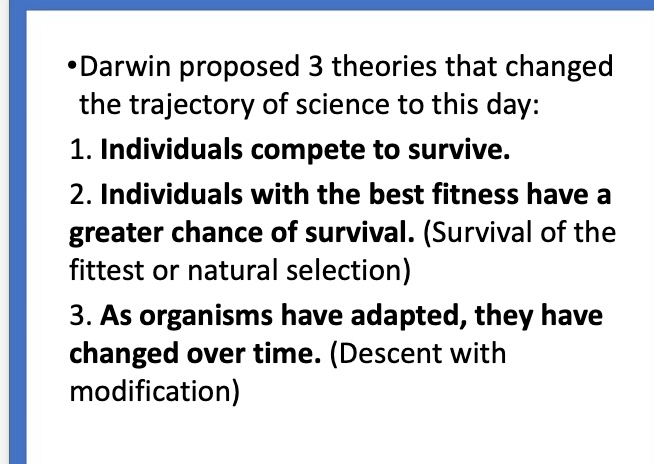
4) What are the 3 major points of Darwin’s theory?
100
8) How does genetic evidence point to natural selection?
Organisms have similar genes, which provides evidence that they are likely related by a common ancestor (ex: similarities can be seen in the Cytochrome C protein)
100
19) What are the 4 types of isolation that can cause speciation?
Geographical isolation, mechanical isolation, temporal isolation, or behavioral isolation.
200
24) What is the difference between a prezygotic barrier and a postzygotic barrier that causes speciation?
The prezygotic barrier prevents mating, while the postzygotic barrier occurs after mating because the zygote is not viable.
200
10) Explain why dark peppered moths had a greater survival rate during the industrial revolution. What phenomenon is this an example of?
There was a mutated gene that caused peppered moths to have the dark color. Because dark color helped the organisms camouflage and survive on the soot covered trees during the industrial revolution, they had greater survival rates. This is an example of natural selection.
200
18) Give an example of a situation in which the founder effect would occur.
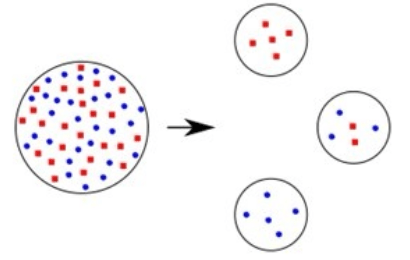
When a portion of the population migrates to a new area and the new population has a different allele frequency than the original population.
200
15) A population with HIGH or LOW genetic diversity is better able to withstand environmental changes. What causes genetic diversity in a population?
High - Mutation creates a new phenotype; gene flow: passing of genes from a different population; sexual reproduction: genes are shuffled during meiosis
300
7) What does the similarity between these structures show about these organisms? What are these structures called?
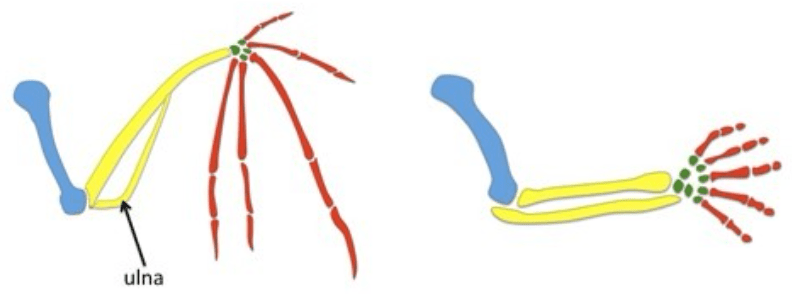
The similarity between the structures in these two organisms shows that the likely evolved from a common ancestor. They are called homologous structures.
300
22) Are all Great White Sharks part of the same gene pool? Why or why not?
Even though these sharks are of the same species, gene pools come from specific populations of sharks and populations are species found at a certain time in a certain place.
300
3) According to Darwin, what would cause finches to have different beak shapes?
Food sources available
300
21) Give an example of how a farmer would use and benefit from artificial selection.
A farmer could replant seeds from the tomato plants that grew the biggest tomatoes. This may help ensure that bigger tomatoes are grown in future crops
400
20) Which island would likely have the most genetic diversity? Why?
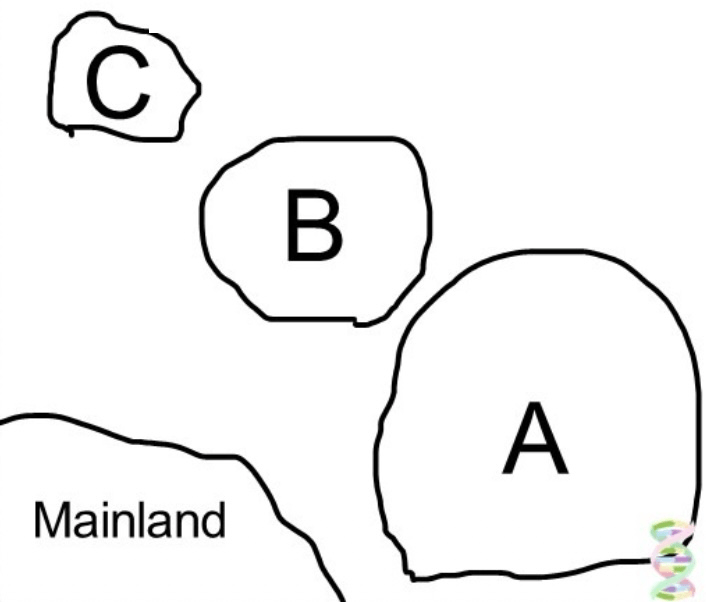
“A” because it is larger and closer to the mainland
400
14) Does natural selection act on genotypes or
phenotypes? Explain why and provide an example to support.
Natural selection acts on phenotypes because they cause individuals to be suited to their environments with higher or lower fitness.
400
23) Why doesn’t a simple dominant trait (like free or attached earlobes) in a population show a normal distribution in a bell curve?
Because it does not have a range of phenotypes- it only has two. Normal distributions are caused by polygenic traits.
400
13) What is a gene pool?
A set of all the alleles within a population
500
5) Looking at how a horse has changed from being the size of a dog with multiple toes to the modern horse we know today supports evolution in the form of . . .
Fossil evidence
500
16) Sketch a graph that shows how the bell curve changes for each of the following types of natural selection on polygenic traits:
Directional selection
Stabilizing selection
Disruptive selection
- Directional selection: the graph should shift to the left or the right as one extreme phenotype becomes better suited for the environment
- Stabilizing selection: the graph should be higher in the middle as the intermediate phenotype shows the best fitness
- Disruptive selection: the graph should decrease in the middle as the intermediate phenotype is the least fit
500
9) You have 5 solid cats (homozygous dominant) and 5 calico cats (heterozygous).
What is the allele frequency for the recessive allele?
Dominant allele?
20 total alleles, 5 are “c”, 15 are “C”.
5 “c” / 20 total alleles = .25
500
2) Explain the ideas that influenced Darwin from 2 of the following scientists:
• Malthus
• Hutton & Lyell
• Lamarck
- Malthus - populations outgrow their environments, causing some individuals to die, not all can survive
- Hutton & Lyell - uniformitarianism, changes on the earth's surface are the result of small changes over long periods of time
- Lamarck - traits an individual picked up during its lifetime could be passed onto offspring (failed theory)