Chapter 1: Human Body- Orientation
Chapter 2: Chemistry Comes Alive
Chapter 3: Cells-the Living Units
Memory Only, No Notes Allowed!
Draw It Out!
100
Explain the difference between anatomy and physiology
Anatomy is the study of the structure/ form, while Physiology is the study of the function of the body parts.
100
What subatomic particle is located in the valence shell and has a negative charge?
Electron
100
Name the 3 major cell regions
Nucleus, Cytoplasm, Plasma Membrane
100
What is the lipid that makes up the plasma membrane?
Phospholipids
100
Draw out the Anatomical Position

200
What is the correct level of organization from smallest to largest?
-Chemical- Cells - Tissue- Organ-Organ System- Organ
200
What is an isotope?
Element that has a same number of protons abut different number of neutrons
200
Explain the difference between passive and active transport?
Passive transport does not require cellular energy and moves substances down their concentration gradient (from high to low concentration), while active transport requires cellular energy, typically ATP, to move substances against their concentration gradient (from low to high concentration)
200
Explain the different types of macromolecules and what they function as:
Carbohydrates provide quick energy and structural support.
Lipids are for long-term energy storage, cell membranes, and insulation.
Proteins catalyze reactions, provide structure, and perform a wide range of cellular work.
Nucleic acids, like DNA and RNA, store and transmit genetic information to direct cell functions.
200
Draw out ionic bond and covalent bond
* Look up ionic and covalent bond diagram*
300
Which of the following body systems function by:
- provides support and protection
- Site of hemopoiesis
- Stores calcium and phosphorus
A. Skeletal System
B. Muscular System
C. Nervous System
D. Integumentary System
A
300
Explain what the first and second laws of thermodynamic are.
First law of thermodynamics:
• Energy can neither be created nor destroyed; it can only change in form.
Second law of thermodynamics:
• When energy is transformed, some energy is lost as heat.
300
If a red blood cell is in a hypertonic solution, what will happen to that red blood cell?
Shrinks ( Crenation)
300
What are the 3 types of membrane junctions and what is their function?
- Tight Junctions (Occluding Junctions): These seal adjacent epithelial cells together, creating an impermeable or selectively permeable barrier that prevents fluid leakage between cells. They are essential for maintaining the integrity of tissue layers.
- Anchoring Junctions (Desmosomes & Adherens): These act like spot welds or ribbons, connecting the cytoskeleton of one cell to another cell or to the extracellular matrix. They provide strong, mechanical attachment that allows tissues to withstand stress.
- Gap Junctions (Communicating Junctions): These form small, protein-lined tunnels (connexons) that connect adjacent cells. They allow for the direct transfer of ions and small signaling molecules, enabling coordinated communication, such as in cardiac muscle contraction.
300
Draw out potential and kinetic energy and explain what the difference is:
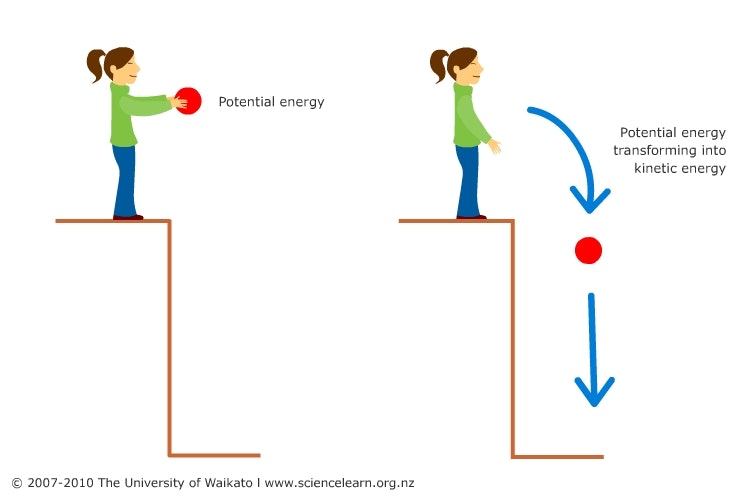
Potential energy is stored energy based on an object's position or state, like a ball held above the ground, while kinetic energy is the energy of motion, possessed by a moving object
400
Why is homeostasis important in the human body and how does it work?
it maintains the stable internal conditions necessary for enzymes and other proteins to function, preventing illness and allowing the body to survive and thrive.
400
A solutin has a pH of 8. Is this an acidic or basic solution and explain what acid or base are:
Basic
They are H+ acceptors
400
List the definitions for the terms: Diffusion, Facilitated Diffusion, and Osmosis and explain why they are all different.
- Diffusion (Simple): Random movement of molecules (e.g., directly through the lipid bilayer, moving from higher to lower concentration.
- Osmosis: A specialized case of diffusion, specifically the movement of water molecules across a semipermeable membrane. Water moves toward areas of higher solute concentration.
- Facilitated Diffusion: Passive transport requiring membrane proteins (channels or carriers) to move large or polar molecules (e.g., glucose, ions) that cannot pass through the lipid bilayer alone.
400
Explain the different types of protein structures:
Primary (amino acid sequence)
Secondary (local folds like alpha-helices and beta-sheets)
Tertiary (overall 3D shape of a single polypeptide chain)
Quaternary (arrangement of multiple polypeptide chains)
400
Draw out and label ATP and where the energy is:
* Look up ATP Structure*
500
Explain the difference between negative feedback and positive feedback and give one example of each one:
Negative feedback opposes a change to maintain stability, working towards a set point, while positive feedback amplifies a change, pushing the system away from its starting state. Positive feedback, less common and often used for rapid completion, amplifies its stimulus, such as in childbirth contractions or blood clotting.
Positive Feedback: Birth, Blood Clotting
Negative Feedback: Temp. Regulation, Hormones, Blood Glucose Regulation
500
What protein structure is this classified is?
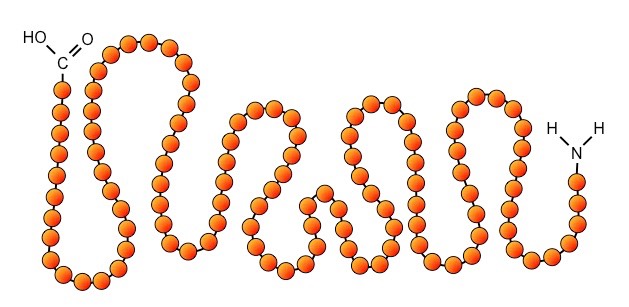
Primary Structure
500
What are the examples of passive and active transport and what do they do?
Passive Transport (No Energy Used)
- Simple Diffusion: Movement of small, nonpolar molecules directly through the lipid bilayer from high to low concentration.
- Osmosis: The diffusion of water molecules across a selectively permeable membrane. Example: Water moving into plant roots.
- Facilitated Diffusion: Movement of larger or polar molecules (like glucose or ions) through membrane proteins (channels or carriers).
- Purpose: To balance solute concentration on both sides of the membrane, maintaining homeostasis.
Active Transport (Energy Required - ATP)
- Sodium-Potassium Pump: Uses to pump 3 sodium ions out of the cell and 2 potassium ions in, crucial for nerve signals.
- Endocytosis: The cell membrane engulfs external materials (like bacteria or nutrients) into a vesicle.
- Exocytosis: The process of exporting substances (like neurotransmitters or waste) out of the cell via vesicles.
- Purpose: To maintain specific, high-concentration gradients required for cell function (e.g., nerve impulses, nutrient uptake).
500
Explain all the different types of protein functions in the plasma membrane.
- Transport Proteins: Move ions and molecules across the lipid bilayer. They include channels (facilitated diffusion) and active transport pumps (requiring ATP).
- Receptor Proteins (Signal Transduction): Act as receptors that bind to external chemical messengers (like hormones), changing shape to transmit signals into the cell.
- Enzymatic Activity: Embedded enzymes catalyze specific chemical reactions on the inner or outer surface of the membrane, such as those in metabolic pathways.
- Cell-Cell Recognition: Glycoproteins or proteins acting as markers allow cells to identify one another, which is critical for immune system responses.
- Intercellular Joining (Junctions): Proteins connect neighboring cells, forming tight junctions or gap junctions for structural stability and communication.
- Anchorage/Attachment: Peripheral proteins attach to the cytoskeleton or the extracellular matrix (ECM) to maintain cell shape, provide structural stability, and enable cell motility.
500
Draw out a combustion chemical structure and explain what the reactant and products is:
* Look up combustion chemical reaction*