That's Life
Chem
Surprise
Cells
Insane in the Membrane
100
This is the difference between prokaryotes and eukaryotes.
PRO- smaller, less complex, free floating dna
EUK- large, complex, membrane bound dna
100
What is found in an atom? (3 things)
Subatomic particles:
1. proton
2. neutron
3. electron
100
What language is used to identify organisms?
Latin
100
Green organelle, used for energy production, only found in plants.
Chloroplast
100
What is the function of a cell membrane.
regulates what enters/leaves the cell.
200
This is the correct scientific way to name a species. (2 words)
Binomial nomenclature
genus species
200
Name the 4 groups of macromolecules
Carbohydrate
Lipids
Proteins
Nucleic Acid
200
Lipids store _______.
energy
200
removes waste from cells
lysosome
200
What is hydrophobic on a phospholipid?
Tails
300
Cladograms are based on these.
Traits
300
What is an enzyme? What does it end in?
A catalyst that speeds up reactions.
Ends in -ase
300
Which animal is the closet relative to rodents.
Primates
300
This type of cell has free-floating DNA
prokaryotes
300
What are three types of passive transport?
Osmosis
Diffusion
Facilitated Diffusion
400
There are 8 characteristics of life. Name 4.
Has cells
Maintains homeostasis
Responds to stimulus
Can reproduce
Obtains and uses energy
Grows and develops
Has genetic makeup
Can evolve
400
A solution with a pH of 11 has this concentration of H+ (High or Low)
Low
400
What type of activation energy is show?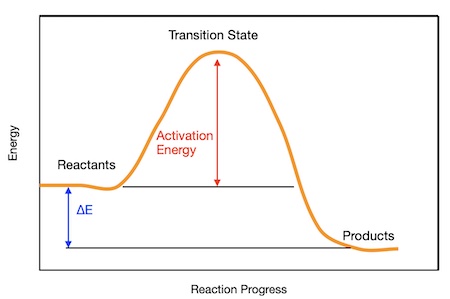
Energy releasing
400
This region in the nucleus is involved in ribosome production.
Nucleolus
400
When a cell “shrinks” in a solution.
hypertonic
500
What is the correct order of classification?
Kingdom, Phylum, Class, Order, Family, Genius, Species
500
This model demonstrates how enzymes “fit”
Lock and Key Model
500
This type of active transport moves molecules like Sodium and Potassium.
Protein pump
500
The cytoplasm of the cell is similar to this structure in a chloroplast.
stroma
500
What would happen if a phospholipid were to be put in oil?
This one is a doozy. I hope you don't flip out...
Phospholipids would arrange so that hydrophilic heads are outside, hydrophobic tails inside