Graphs & Equations
Converting Equations
Intercepts
Vertex & A.O.S
100
Does the parabola of the equation below have a maximum or minimum and what is the value?
y=-(x-3)^2-9
Parabola has a maximum since it opens down since a=-1
The y value of the vertex is -9, so
The parabola has a maximum of -9
100
Rewrite in standard form.
y=(x-4)(x+3)+4
y=(x-4)(x+3)+4
y=x^2-4x+3x-12+4
y=x^2-x-8
100
What is the y-intercept?
y=x^2+3x+2
y-intercept in standard form is the "c" value
so, y-intercept is
2
100
Find the axis of symmetry.
f(x)=(x+1)^2-8
Axis of symmetry is the vertical line down x-value of vertex "h":
x=-1
200
What is the equation of this graph in vertex form?
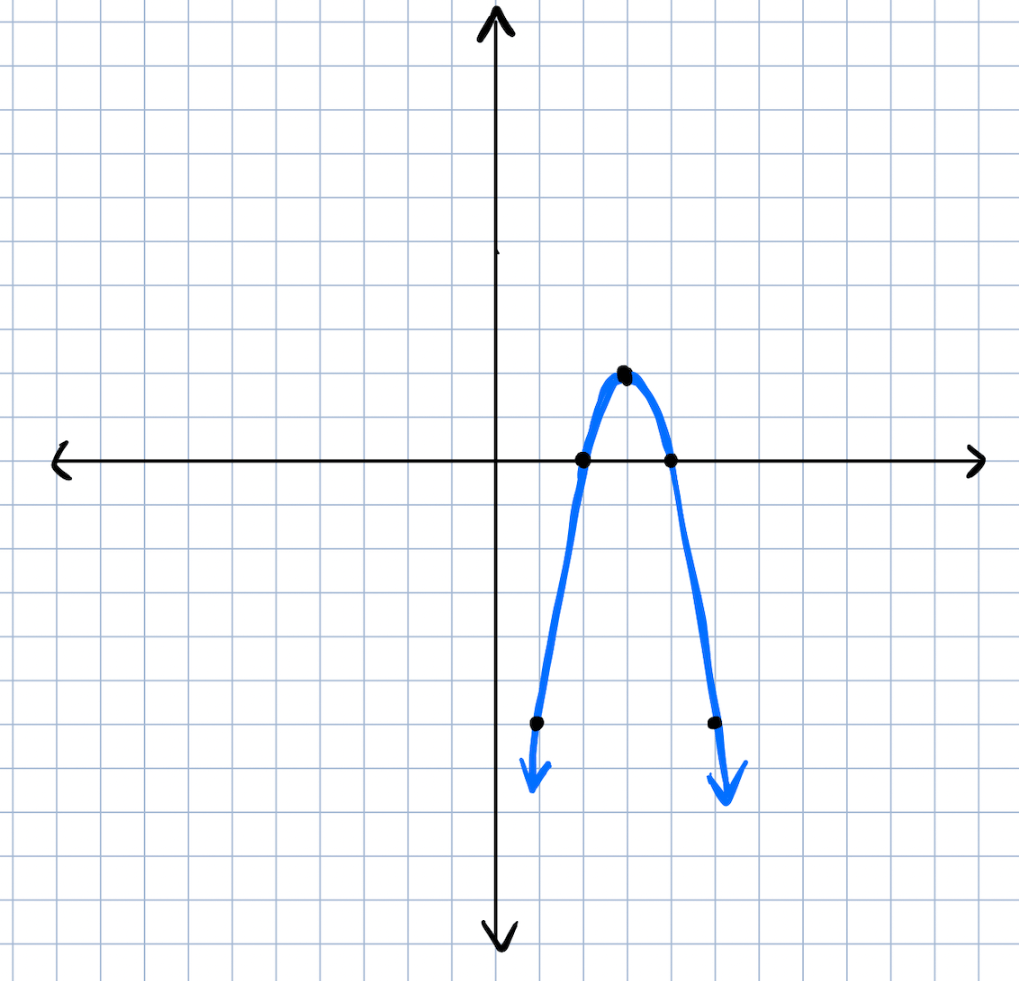
Have vertex so use vertex form
vertex is (h,k):
(3, 2)
a is the slope 1 unit to the right:
-2
So, the vertex form is:
y=−2(x−3)^2+2
200
Rewrite in vertex form
f(x)=−2x^2+8x−5
Use a from standard form and find vertex (h, k)
a=-2
h=(-b)/(2a)=(-8)/(2(-2))=(-8)/(-4)=2
k=−2(2)^2+8(2)−5=3
so, vertex form is:
f(x)=−2(x-2)^2+3
200
What are your x-intercepts?
y=x^2-6x+5
To find x-intercepts from standard form set y=0 and solve for x
y=x^2-6x+5
y=(x-1)(x-5)
So, x-intercepts are
1 and 5
200
Find the vertex
y=(x-3)^2+4
From vertex form, vertex is (h, k)
so, vertex: (3, 4)
300
What is the equation of this graph in standard form?
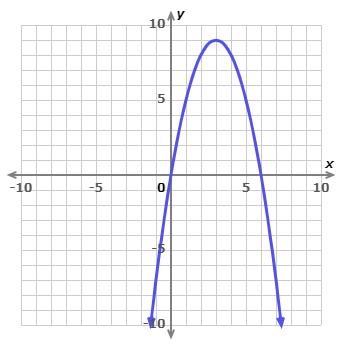
Have vertex so use vertex form, then simplify it to get standard form
vertex is (h,k):
(3, 9)
a is the slope 1 unit to the right:
-1
So, the vertex form is:
y=−1(x-3)^2+9
Simplify for standard form:
y=−1(x-3)(x-3)+9
y=−1[x^2-3x-3x+9]+9
y=−1x^2+3x+3x-9+9
So, standard form is:
y=−1x^2+6x
300
Rewrite in standard form.
f(x)=-2(x-1)^2-1
f(x)=-2(x-1)^2-1
f(x)=-2(x-1)(x-1)-1
f(x)=-2[x^2-1x-1x+1]-1
f(x)=-2x^2+2x+2x-2-1
f(x)=-2x^2+4x-3
300
What are the x-intercepts and the y-intercept?
y=(x+5)(x-7)
From factored form x-intercepts are the p and q values(remember they are opposites)
So, x-intercepts are
-5 and 7
From factored form the y-intercept can be found by setting x=0 and solving for y
y=(0+5)(0-7)=(5)(-7)=-35
So, y-intercept is
-35
300
Find the axis of symmetry.
y=x^2-4x-5
Axis of symmetry is the vertical line down x-value of vertex "h", in standard form
h=(-b)/(2a)
h=(-(-4))/(2(1))=4/2=2
So, A.O.S.: x=2
400
Write the equation for the graph below in vertex form.
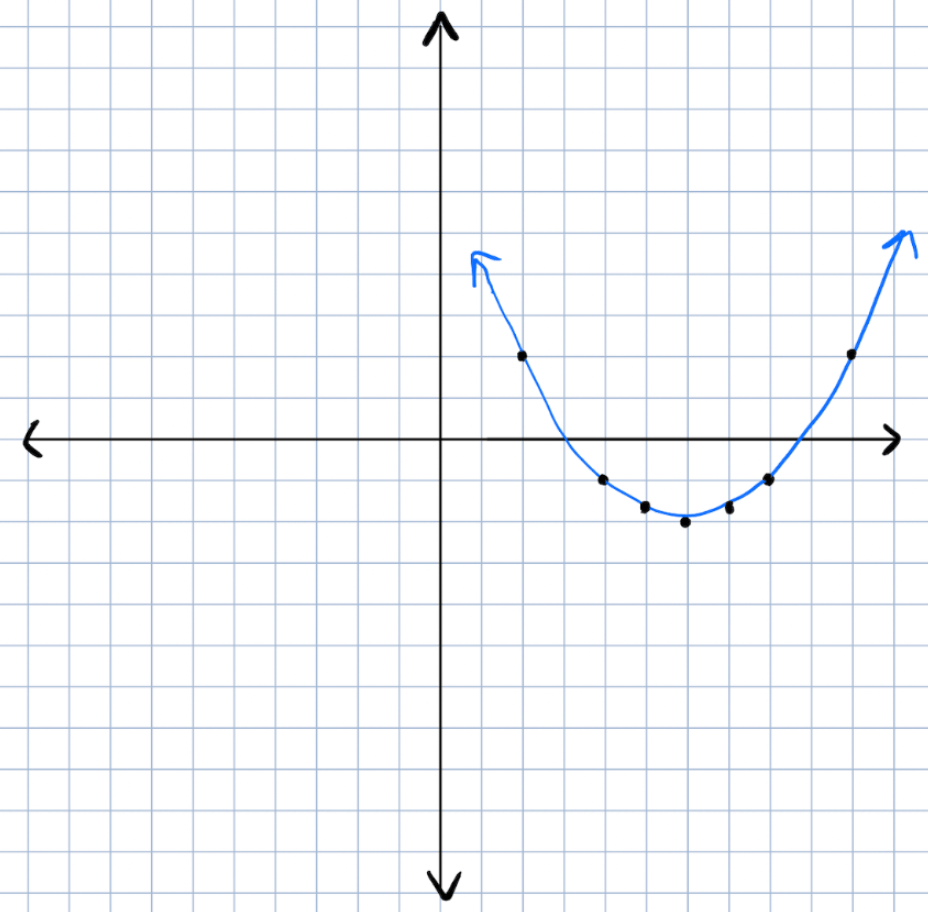
Have vertex so use vertex form
vertex is (h,k):
(6, -2)
a is the slope 1 unit to the right, but we cant tell exactly how far down its going exactly so solve using random (x, y) point:
Using (4, -1) as (x,y)
-1=a(4-6)^2-2
-1=a(-2)^2-2
-1=4a-2
1=4a
1/4=a
So, the vertex form is:
y=1/4(x-6)^2-2
400
Rewrite in standard form.
y=1/4(x+1)^2-4
y=1/4(x+1)^2-4
y=1/4(x+1)(x+1)-4
y=1/4[x^2+1x+1x+1]-4
y=1/4x^2+1/4x+1/4x+1/4-4
y=1/4x^2+1/2x-15/4
400
Find the x-intercepts
y=-(x+3)^2+4
To find x-intercepts from vertex form set y=0 and solve for x, use the square root method for solving
0=-(x+3)^2+4
-4=-(x+3)^2
4=(x+3)^2
+-2=x+3
x=-3+-2
So solutions are
-3+2 and -3-2
-1 and -5
400
Find the vertex.
y=3(x-4)(x+16)
Vertex from factored form (h,k) find h using formula below, then plug in to find k.
h=(p+q)/2
h=(4+ -16)/2=(-12)/2=-6
k=3(-6-4)(-6+16)=3(-10)(10)=-300
so, vertex: (-6, -300)
500
Write the equation in standard form
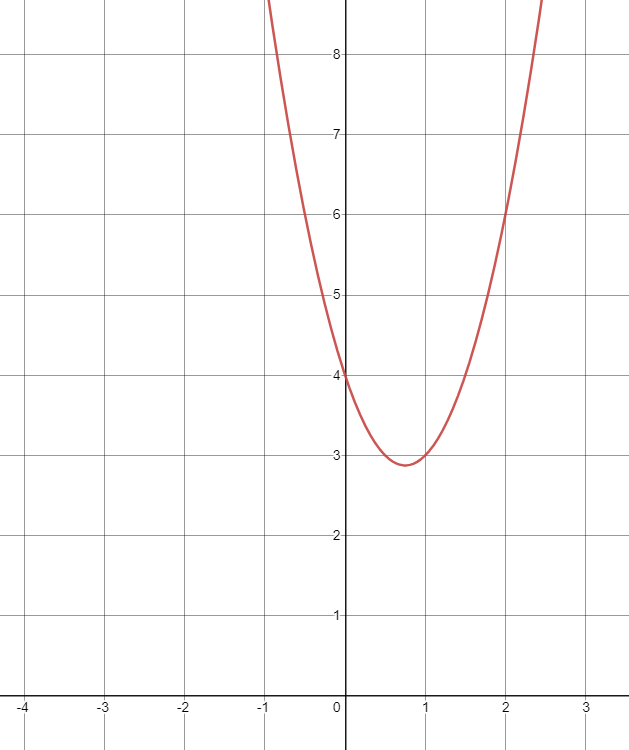
DONT have vertex so use standard form
y-intercept is c:
4
we need to solve for a and b by picking 2 random (x, y) points and making a system of equations with it:
Using (1, 3) and (2, 6)
{(3=a(1)^2+b(1)+4),(6=a(2)^2+b(2)+4):}
{(-1=a+b),(2=4a+2b):}
{((-1=a+b)(-2)),(2=4a+2b):}
{(2=-2a-2b),(2=4a+2b):}
Add together
4=2a
2=a
Plug in a to find b
-1=2+b
-3
So, the standard form:
y=2x^2-3x+4
500
Rewrite in vertex form
f(x)=3x^2+9x+6+3x-7
First simplify to standard form:
f(x)=3x^2+12x-1
Use a from standard form and find vertex (h, k)
a=3
h=(-b)/(2a)=(-12)/(2(3))=(-12)/6=-2
k=3(-2)^2+12(-2)−1=-13
so, vertex form is:
f(x)=3(x+2)^2-13
500
Find the y-intercept
f(x)=3(x+2)^2+2
To find y-intercept from vertex form set x=0 and solve for y
f(0)=3(0+2)^2+2
f(0)=3(2)^2+2
f(0)=3(4)+2
f(0)=12+2
f(0)=14
So, y-intercept is
14
500
Find the vertex.
y=1/2x^2+3x+4
Vertex from factored form (h,k) find h using formula below, then plug in to find k.
h=(-b)/(2a)
h=(-3)/(2(1/2))=(-3)/1=-3
k=1/2(-3)^2+3(-3)+4=-1/2
so, vertex: (-3, -1/2)