Species differences
Bones of the body
Muscles
Ligaments
Conformation and gait
100
This is the evolutionary difference seen in large animals that allows for the storage of elastic energy in the distal limbs
Replacement of muscles with tendons and ligaments
100
This is the main bone of the thigh
Femur
100
The primary action of this muscle is to flex the elbow
Biceps brachii
100
What are the main functions of ligaments? (3)
Connect bone to bone, stabilize joints, limit joint movement
100
What is the limb deformity in this picture?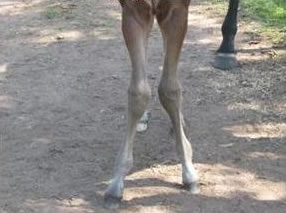
Carpal valgus
200
The clavicle is absent in this species
Dogs
200
These bones lie dorsally on the animal and articulate with the ribs
Thoracic vertebrae
200
In relation to the actions of muscles and how they work together, what is the name of the muscle that assists the primary mover? (e.g. the role the brachialis plays in elbow flexion)
Synergist muscles
200
This ligament is also a tendon and is the main one that stretches during the "knee jerk" reflex
Patellar ligament (tendon)
200
The movement of an animal's limb can be divided into these two phases
Swing and stance phases
300
The acromion process is not present in these two species
Horses and pigs?
300
These bones constitute the ankle bones
Tarsal bones
300
This group of muscles is the main antagonist to the quadriceps for extension during knee movement
Hamstring muscles
300
This ligament in the stifle of dogs is most at risk for damage when the stifle is extended
Cranial cruciate ligament
300
This cue can indicate equine forelimb lameness
Head drop on when the good foot strikes the ground
400
This difference can be seen when looking at the distal canine and feline humerus
Supracondylar foramen (feline) vs supratrochlear foramen (canine)
400
This bone marks the caudal end of the sternum
Xiphoid bone
400
These three muscles adduct the hindlimb
Gracilis, the adductor, and the pectineus
400
These two ligaments comprise the reciprocal apparatus
Superficial digital flexor tendon (SDFT) and peroneus tertius
400
Severing the common calcaneal tendon in a dog leads to this type of stance
Plantigrade stance
500
This species has a completely fused radius and ulna
Bovines
500
This bone sits on the medial aspect of the palmar surface of the equine cannon bone (also known as the splint bone)
2nd metacarpal bone
500
The main protracting/advancing muscle of the forelimb
Omotransversarius muscle
500
This ligament that bridges the acetabular notch
The transverse acetabular ligament
500
What changes will be seen during a dynamic gait evaluation that indicates lameness for a horse at a trot? List 2-3
Reduced stride length, head nod/hip hike, fetlock drop