Factoring Polynomials
Synthetic Division
Asymptotes
Solving Rational Equations
Miscellaneous
100
Factor the polynomial.
x2 - 13x + 40
(x - 5)(x - 8)
100
Use Synthetic Division to divide the following equation:
(x2-3x-40)/ (x+5)
x-8
100
What is an asymptote? Explain in your own words.
Varies!
100
3x-1/4 = 2
3
100
What is the end behavior of the function:
y = -x3 + 5x2 - 1005
As x-> -infinity, y-> infinity
As x-> infinity, y-> -infinity
200
Factor the polynomial and find the zeros.
x2 - x - 56
x = 8 and x = -7
200
Use Synthetic Division to solve the following equation:
(x3+3x2-x+2)/(x-1)
x2+4x+3, R:5
200
Find the vertical asymptote of the function.
y = 1/4x-6
x=1.5 or 3/2
200
2x/x-1 = x+6/-x+1
-2
200
What are the multiplicities of each x-intercept on the graph?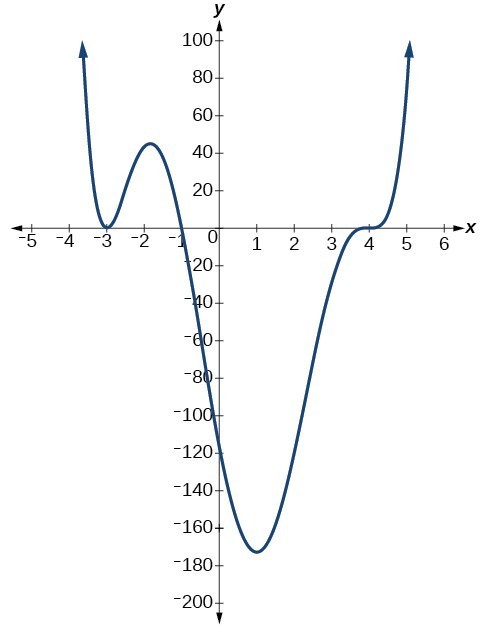
At x = -3, the multiplicity is 2.
At x = -1, the multiplicity is 1.
At x = 4, the multiplicity is 3.
300
Factor the polynomial and find the zeros:
5x2 + 19x + 12
x=-4/5, and x=-3
300
Use Synthetic Division to solve the following equation:
(x3+27) / (x+3)
x2-3x+9
300
Explain when the horizontal asymptote is 0 and when there is no horizontal asymptote.
When the denominator degree is bigger than the numerator degree, the horizontal asymptote is 0.
When the numerator degree is bigger than the denominator degree, there is no horizontal asymptote.
300
x + (x/x+2) = 5x+8/x+2
4
400
Factor the polynomial:
x3+7x2+10x
x(x+5)(x+2)
400
Use Synthetic Division to solve the following equation:
(x4+3x3+x+4) / (x+3) then, use the remainder theorem to explain whether or not (x + 3) is a factor of (x4+3x3+x+4).
x3 + 1, R:1 no, it is not a factor because the remainder is not 0 and when we substitute -3 into the polynomial, we get 1, not 0.
400
Find the horizontal and vertical asymptotes.
y = (5x2 + 3)/(3x2 - 8x + 4)
HA: y = 5/3
VA: x = 2 and x = 3/2 or 1.5
400
x+10/x2-2=4/x
x = -2/3 and x = 4
500
Factor the polynomial:
9x3+6x2-3x
3x(3x-1)(x+1)
500
Use Synthetic Division to solve the following equation:
(x5+1) / (x+1) then, use the remainder theorem to explain whether or not (x+1) is a factor of x5 + 1.
x4-x3+x2-x+1, yes it is a factor because the remainder was 0 and when we substitute the zero (-1) into the polynomial x5 + 1 we get 0.
500
Find the asymptotes.
y = 3x3 - 1/x2 + 2x
VA: x = 0, x = -2
HA: None
Slant Asymptote: 12x - 1