Features of Functions
More Features of Functions
Analyzing Functions
Interpreting Graphs
100
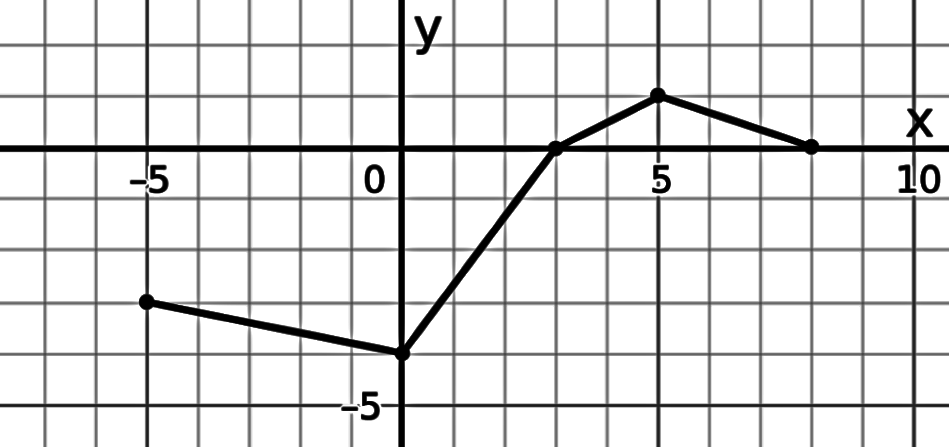
What are the coordinates of the y-intercept?
(0, -4)
100
What are the coordinates of an x-intercept? Double points for naming BOTH x-intercepts.
(3, 0) and (8, 0)
100

If x = 3, f(3) =
0
200
What are the coordinates of a minimum? Double points for getting BOTH minimums.
(0, -4) and (8, 0)
200
What are the coordinates of a maximum? Double points for getting BOTH maximums.
(-5, -3) and (5, 1)
200
If f(x) = 1, then x =
5
300
What is the domain of the graph? Be sure to use correct notation!
-5<x< 8
300
What is the range of the graph?
-5<y<1
300
The distance that a dog can run in feet is measured based on how many seconds he has been running. This distance can be modeled by the function d(t) = 10t, where d(t) is the distance in feet at time t in seconds.
How far has the dog run in 3 seconds?
30 feet
3 seconds means t = 3
300
If x = -5, f(-5) =
-3
400
What is the interval of increase? Notation is critical!
0<x< 5
400
What is an interval of decrease? Put the x value at the start of the interval and the x value at the end of the interval inside brackets like [X1, X2]. Double points for getting BOTH intervals of decrease.
-5<x< 0 and 5<x< 8
400
The distance that a dog can run in feet is measured based on how many seconds he has been running. This distance can be modeled by the function d(t) = 10t, where d(t) is the distance in feet at time t in seconds.
If the dog has run 60 feet, how long has the dog been running?
6 seconds
60 feet means d(t) = 60
400
If f(x) = -4, x =
0
500
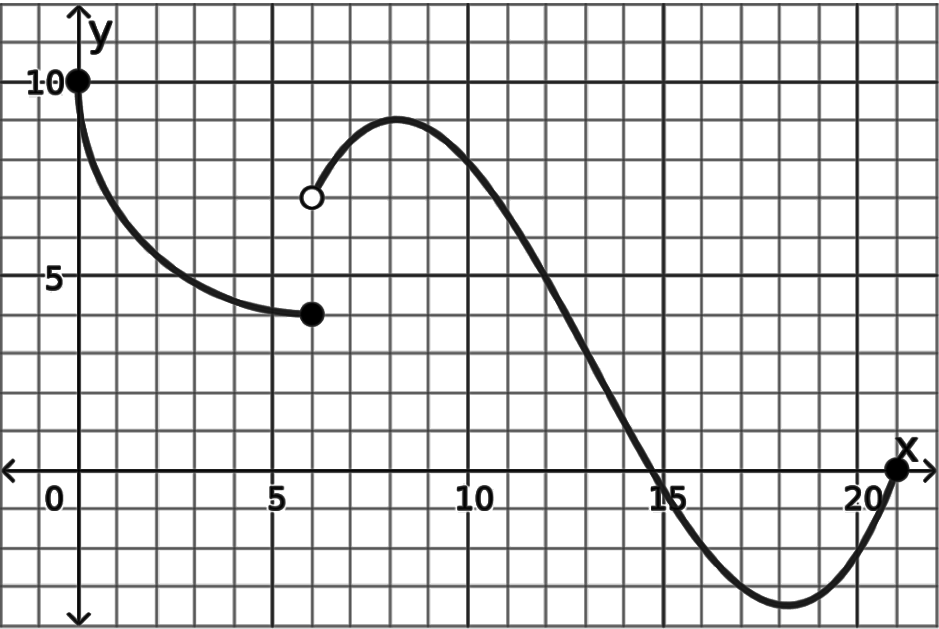
What is the domain of the graph?
0<x<21
500

What is the range of the graph (the set of all the y-values, set inside [brackets])?
[-3.5, 10]
500
The distance that a dog can run in feet is measured based on how many seconds he has been running. This distance can be modeled by the function d(t) = 10t, where d(t) is the distance in feet at time t in seconds.
How long has the dog been running if d(t) = 255?
25.5 seconds
d(t) = 255, 255 = 10t. Divide both sides by 10.
500
If x = 4, f(4) =
0.5 or 1/2